

Audi Performance Parts Online Shop: 7 Upgrades That Work
Table of Contents
- How to Buy Audi OEM Parts Online Without Fitment Headaches
- The Best Audi Performance Upgrades, Ranked by Stage
- Audi Tuning Software and ECU Calibration: What Actually Changes
- Intake, Exhaust, and Intercooler Upgrades That Support More Power
- Brakes, Coilovers, and Chassis Parts for Audi Performance
- Installation Difficulty and Warranty Impact: What to Know First
- Real-World Dyno Results and How to Read Them
- Frequently Asked Questions
Last Updated: September 14, 2026
How to Buy Audi OEM Parts Online Without Fitment Headaches
The fastest way to avoid fitment problems with Audi performance parts is to match your VIN to a genuine OEM part number before you order, not after. At EUROPEAN OEM PARTS, we see the same story every week: an enthusiast orders a discounted suspension component, waits four days, then discovers it doesn't clear the factory strut mount. That return costs time and shipping, and it's almost always preventable.
Genuine OEM parts are components manufactured to the vehicle's original factory specifications and sold under the automaker's own part number. That's the difference between a part that bolts on the first time and one that needs a bracket you have to fabricate yourself.
Before you buy Audi OEM parts online, run this quick check:
- Locate your VIN on the driver-side dashboard or door jamb
- Pull the factory part number from a dealer parts diagram
- Confirm the part number's supersession chain (old numbers get replaced)
- Verify the listing states "OEM" and lists the manufacturer part number
- Cross-check the fitment note against your model year and trim
NHTSA's vehicle specification lookup by VIN lets you confirm your exact model year and trim before ordering, which matters because Audi changed mounting points mid-generation on several platforms.
The Best Audi Performance Upgrades, Ranked by Stage
The best Audi performance upgrades follow a stage-based path: start with software and intake, add exhaust and intercooling, then move to suspension and brakes before chasing big power. Skipping stages is how people end up with a car that makes more horsepower than it can put down.
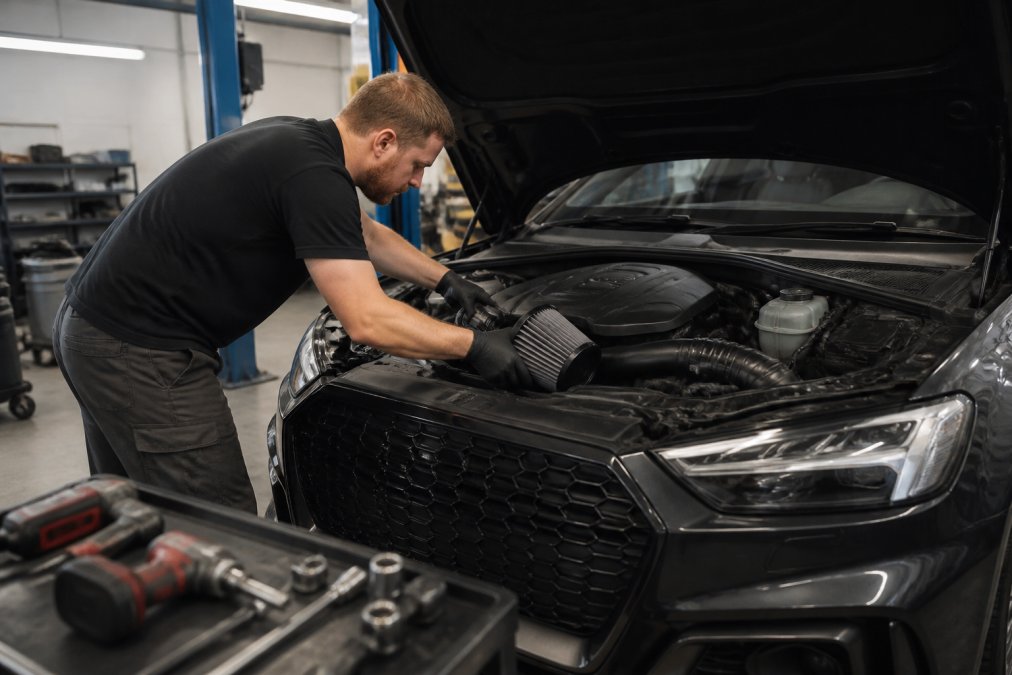
Here's the upgrade path most enthusiasts should follow:
| Stage | Typical Upgrades | Difficulty | Warranty Impact |
|---|---|---|---|
| Stage 1 | ECU software, drop-in filter | Low | High (flags tune) |
| Stage 2 | Downpipe, intercooler, intake | Medium | High |
| Stage 3 | Turbo upgrade, fueling | High | Severe |
| Handling | Coilovers, sway bars | Medium | Low to none |
| Braking | Pads, rotors, big brake kit | Medium | Low |
Stage tuning works because each layer supports the next. A downpipe without software leaves power on the table; software without an intercooler heat-soaks after two pulls.
Audi Tuning Software and ECU Calibration: What Actually Changes
Audi tuning software changes the engine control unit's calibration tables for boost, fueling, ignition timing, and throttle mapping. ECU remapping, sometimes called chiptuning, rewrites those tables to extract more power from the hardware you already have.
What actually changes when you flash a tune:
- Boost targets rise, so the turbo works harder
- Fueling and ignition advance adjust for the new airflow
- Throttle response sharpens, especially on turbocharged models
- Rev limits and launch behavior may shift
A common mistake is buying a tune before confirming your hardware can support it. Software calibration is only as good as the intercooler and exhaust flow behind it.
Intake, Exhaust, and Intercooler Upgrades That Support More Power
Intake, exhaust, and intercooler upgrades support more power by reducing restriction and controlling intake air temperature. A cold air intake and cat-back exhaust free up airflow; an intercooler keeps that air dense so the ECU can safely run more boost.
The parts that matter most, in order:
- Cold air intake: improves throttle response and intake sound, modest power gains alone
- Downpipe: the single biggest exhaust restriction on turbocharged Audis
- Cat-back exhaust: exhaust flow and tone, minimal power on its own
- Intercooler: prevents heat soak, unlocks consistent power on repeated pulls
- Diverter valve: holds boost reliably once you raise pressure
Fitment matters here more than anywhere else with Audi performance parts. An aftermarket downpipe must match your engine code and emissions configuration, and an OEM replacement intercooler avoids the mounting bracket guesswork that generic units bring.
EPA information on vehicle emissions and aftermarket parts is worth reading before you modify exhaust components, since tampering with emissions equipment carries legal consequences in most states.
Brakes, Coilovers, and Chassis Parts for Audi Performance
Brakes, coilovers, and chassis parts decide whether your power is usable. Coilovers and sway bars sharpen suspension geometry and reduce body roll; a big brake kit and upgraded pads deliver the braking performance that higher speeds demand.
Priority order for most builds:
- Brake pads and rotors first, always
- Coilovers for adjustable ride height and damping
- Sway bars to tune front-to-rear balance
- Big brake kit once you're consistently on track
- Chassis reinforcement for high-mileage or heavily modified cars
Suspension geometry changes when you lower a car, so budget for an alignment after any coilover install. Skip it and you'll chew through tires faster than you'd expect.
Installation Difficulty and Warranty Impact: What to Know First
Installation difficulty and warranty impact should shape your upgrade order more than horsepower figures do. Software and bolt-on parts are easy to install but carry the heaviest warranty risk; suspension and brake work is harder but rarely voids coverage.
DIY vs. Professional Install Ratings
Use this as a planning tool, not a rulebook. Times assume a lift, hand tools, and no seized fasteners, the two things that wreck every estimate.
| Upgrade | Install Time | Skill Level | Tools You Actually Need | Warranty Risk |
|---|---|---|---|---|
| Drop-in filter | 15 min | Beginner | Screwdriver | None |
| ECU tune (flash) | 30 min | Beginner | Laptop, OBD cable | High |
| Cat-back exhaust | 1-2 hrs | Beginner | Sockets, penetrating oil | Low |
| Downpipe | 3-4 hrs | Intermediate | Sockets, O2 sensor tool, jack stands | High |
| Intercooler (OEM-location) | 2-3 hrs | Intermediate | Sockets, trim tools | Low to moderate |
| Coilovers | 4-6 hrs | Advanced | Spring compressor, torque wrench, alignment after | Low |
| Big brake kit | 3-5 hrs | Advanced | Torque wrench, brake bleeder | Low |
| Turbo upgrade | 10+ hrs | Professional | Specialty tooling, dyno session | Severe |
A common pattern: the parts that take the least time to install are the ones most likely to trigger a warranty conversation. That's not a coincidence, a flash tune leaves a footprint in the ECU's flash counter and boost logs that a dealer scan tool can read.
Warranty-Safe vs. High-Risk: A Practical Framework
Under the Magnuson-Moss Warranty Act, a manufacturer can't void your entire warranty just because you installed aftermarket parts. They can deny coverage for a specific failure they can prove your part caused. That distinction is the whole game.
Sort every modification into one of three buckets before you buy:
- Warranty-safe (low risk): consumables and wear items, brake pads, rotors, filters, fluids, tires. These are expected to be replaced. Keep receipts.
- Gray zone (moderate risk): cat-back exhausts, coilovers, sway bars, wheels. A dealer would have to argue the part caused the failure. Document the install and keep the stock parts.
- High risk (likely denial on related claims): ECU tunes, downpipes, turbo upgrades, fueling changes. These directly alter the powertrain parameters the warranty covers.
The Leased-Car Question
If your car is leased, the calculus changes. Lease agreements typically require the vehicle to be returned in factory condition, and a flash tune or downpipe is a return-condition problem, not just a warranty problem. Most lessees who modify either revert to stock before turn-in or buy out the lease. Factor that reversal cost into your budget before you order anything.
Real-World Dyno Results and How to Read Them
Dyno results tell you what a part actually did on a specific car on a specific day, not what it will do on yours. Horsepower gains and torque delivery vary with fuel, ambient temperature, altitude, and whether the shop corrected the numbers to a standard. Most retailers skip this nuance and quote a peak number from a marketing sheet, that's the gap this section fills.
The Five Questions That Separate Real Data From Marketing
When you read a dyno sheet, yours or someone else's, check these in order:
- Was the pull corrected to a standard? SAE J1349 and STD are the two you'll see in the U.S. SAE correction normalizes to a fixed temperature, pressure, and humidity; STD is less conservative and reads higher. A sheet that doesn't state the correction standard is not comparable to anything.
- What fuel was in the tank? A pull on 93 octane and a pull on E30 are different tests. If the sheet doesn't say, assume pump 91 and treat any gain claim as optimistic.
- Was it a before-and-after on the same dyno, same day? This is the only comparison that isolates the part. Cross-shop comparisons, "our downpipe made 22 whp on our dyno, their intake made 18 on theirs", are meaningless.
- Where in the rev range does the gain land? A tune that adds peak horsepower at redline but loses torque delivery at 3,000 rpm will feel slower in daily driving. Look at the area under the curve, not the single peak number.
- Was the hood closed and a fan on the intercooler? Heat soak on a turbocharged Audi can erase 20-30 whp between the first and third pull. A shop that runs three pulls back-to-back without cooling is measuring heat soak, not the part.
Reading Area Under the Curve, Not Peak
Peak horsepower is a single point. Torque delivery across the rev range is what you feel. When you compare two dyno sheets for the same car, overlay the curves and ask:
- Does the modified curve stay above the baseline from 2,500 rpm to redline, or does it cross back below in the midrange?
- Is the torque plateau wider, or just taller?
- Did the tune shift the powerband higher, which helps on track but hurts around town?
A downpipe and tune combo that adds 30 whp at 6,500 rpm but loses 15 lb-ft at 3,000 rpm is a track-biased setup. The same combo with a flatter curve is the better daily. Neither is "better", they're different tools, and the dyno sheet is how you tell them apart.
What to Ask Before You Buy Based on a Dyno Claim
If a shop or retailer publishes dyno results for a part you're considering, ask for the baseline pull, the correction standard, the fuel, and the ambient conditions. A reputable shop will have all four. If they don't, the number is a sales tool. The most useful thing you can do is baseline your own car on a local dyno before you start modifying, that gives you a personal reference point no marketing sheet can replace.
Frequently Asked Questions
What is the website for buying genuine Audi parts?
Genuine Audi parts come from authorized dealers and specialty retailers that stock OEM components. European OEM Parts carries authentic Audi, Porsche, and Volkswagen parts with fast nationwide shipping and exclusive pricing. Every listing includes the manufacturer part number, like 8W0-601-170 for a center cap, so you can verify the part matches your vehicle before ordering. Check the part number against your VIN or factory specifications to confirm fitment.
What are the best performance parts for an Audi?
Start with a cold air intake and cat-back exhaust for modest horsepower gains and better throttle response. From there, ECU remapping, an upgraded intercooler, and a downpipe support more power. For handling, coilovers and sway bars sharpen cornering, while a big brake kit improves stopping power. The best sequence depends on your goals: daily driving, track days, or a full stage tuning build. Match each part to your engine code and drivetrain.
Do performance parts void my vehicle warranty?
Under the Magnuson-Moss Warranty Act, a dealer cannot void your entire warranty just because you installed aftermarket parts. They must show the part caused the specific failure. However, tuning software and drivetrain modifications can lead to denied claims on related components. Keep receipts, use OEM replacement parts where possible, and check your warranty terms before installing engine or transmission upgrades. Some dealers are stricter than others.
What is the difference between OEM and aftermarket performance parts?
OEM parts are made by or for Audi to factory specifications, so fitment and materials match what came on your car. Aftermarket parts are built by third parties and vary widely in quality. For performance upgrades, aftermarket brands often offer more aggressive tuning, but OEM parts win on reliability and vehicle compatibility. If you want factory standards with added performance, look for OEM replacement parts designed for higher-output trims.
Where can I get Audi performance parts online?
Look for an online shop that stocks genuine OEM components and lists part numbers, pricing, and fitment data. European OEM Parts offers Audi performance parts with transparent pricing, like a forged alloy wheel at $629.00 or an S-line trim set at $525.00. Confirm the part fits your model year and engine code before ordering, and check the return policy if you are unsure about compatibility.
Building an Audi that's genuinely faster, sharper, and still reliable comes down to choosing the right parts in the right order, and sourcing components you can actually trust. EUROPEAN OEM PARTS stocks genuine Audi, Porsche, and Volkswagen components with fast nationwide shipping, so you get authentic parts and exclusive pricing instead of fitment gambles. Browse the catalog, confirm your part number, and get your build moving.