

Audi vs VW Engine Parts Compatibility: What Fits
Table of Contents
- Quick Comparison: Audi and VW Engine Parts at a Glance
- Why Audi and VW Share So Many Engine Components
- How to Check Audi Part Numbers Before You Swap Anything
- Aftermarket vs OEM Engine Components: What Actually Interchanges
- Where Compatibility Breaks: Drivetrain, Electrical, and ECU Coding
- Where to Buy Audi OEM Parts Online Safely
- Risks of Using Non-Specific or Mismatched Engine Parts
- Frequently Asked Questions
Last Updated: September 15, 2026
Quick Comparison: Audi and VW Engine Parts at a Glance
Audi and VW engine parts compatibility comes down to one fact: the two brands share engine families, and many hard components interchange directly. Blocks, heads, and rotating assemblies often match; mounts, sensors, and software frequently don't.
This guide from EUROPEAN OEM PARTS breaks down what fits, what shouldn't be swapped, and how to verify a part before buying.
| Component | Usually Interchangeable? | What Decides It |
|---|---|---|
| Cylinder head castings | Often yes | Engine code, not brand |
| Pistons and rods | Sometimes | Compression ratio, bore, engine code |
| Timing chain kits | Often yes | Engine code and revision |
| Water pumps | Usually yes | Engine code and accessory layout |
| Transmission mounts | Rarely | Chassis code, drivetrain layout |
| Sensors (MAF, O2, MAP) | Sometimes | Calibration and connector type |
| ECUs | Almost never | Immobilizer, coding, software version |
The pattern: mechanical parts built to a shared platform spec tend to swap, while anything tied to electronics, calibration, or chassis geometry needs verification first.
Why Audi and VW Share So Many Engine Components
Platform sharing is why the question exists. Volkswagen Group builds one engine family and installs it across several brands, tuning output and accessories per model. The core architecture, bore spacing, and mounting points stay the same.
Shared Engine Platforms and Engine Codes
Audi and VW share engine families including the EA888 (TFSI) four-cylinder, the EA837 and EA839 V6, and the EA288 (TDI) diesel (the EPA). A 2.0 TFSI in an Audi A4 and one in a VW GTI may be the same base engine with different output ratings, turbochargers, and software.
The engine code is the identifier that matters, not the badge on the grille. Codes like CCTA, CBFA, CYMC, or CREC tell you exactly which variant you have. Two cars with the same displacement can carry different engine codes and different internal parts.
OE Supplier Relationships and Chassis Code Verification
Original equipment suppliers build parts for both brands. A water pump, thermostat housing, or timing tensioner may leave the same factory and go into Audi and VW boxes with different part numbers, which is why an OE-supplier part can fit both applications under a single supplier reference.
Chassis code verification handles the other half: the engine fits the platform, but the platform decides mounts, brackets, and accessories. A B8 A4 and a MK6 Golf may share an engine family while using completely different mounting hardware.
How to Check Audi Part Numbers Before You Swap Anything
Checking a part number means cross-referencing the OE number, confirming the engine code, and verifying the chassis code for anything that bolts to the body.
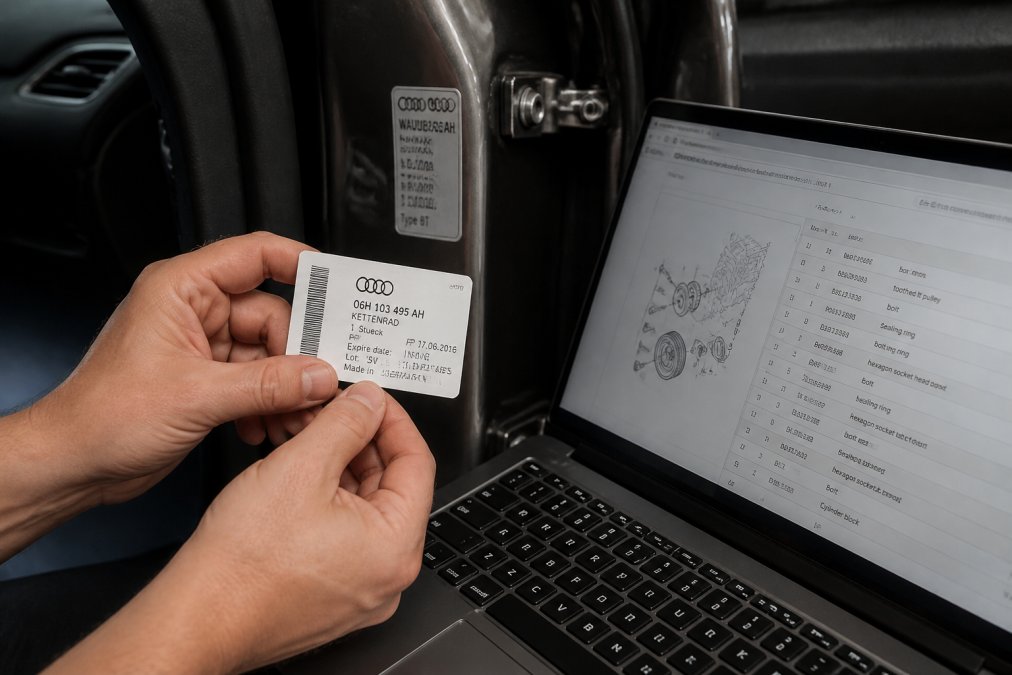
Part Number Cross-Referencing and VIN-Based Tools
A part number is the manufacturer's unique identifier for a component, and cross-referencing it confirms whether two numbers describe the same physical part. Workflow:
- Decode your VIN to confirm model, year, and engine code.
- Pull the OE part number from a factory parts catalog.
- Cross-reference that number against the donor vehicle's catalog entry.
- Check for superseded numbers, since manufacturers revise parts over a model run.
- Confirm the chassis code matches for anything mount-related.
VIN-based tools remove most of the guesswork. Entering a VIN pulls the exact catalog for that build, including options that changed mid-year. Forums are useful for confirming real-world fitment, but they're anecdotal. A NHTSA VIN decoder confirms the vehicle's basic build data, which is the starting point for any cross-reference.
Aftermarket vs OEM Engine Components: What Actually Interchanges
Aftermarket vs OEM engine components is a fitment question first. Aftermarket interchangeability varies wildly by category, and treating all aftermarket parts as one bucket is how DIYers end up with a part that bolts on but doesn't work.
The three tiers of parts you'll encounter:
-
Genuine OEM, built to the manufacturer's specification, sold under the brand's part number (for example, an Audi-ringed box with an
06Kor06Hprefix). Highest confidence, highest price. - OE-supplier, built by the same company that supplies the factory line, often sold without brand packaging. Suppliers like Bosch, Continental, Mahle, and INA build parts that go into both Audi and VW boxes. These frequently interchange across engine codes because the underlying supplier reference is identical.
- Aftermarket, built by a third party to its own interpretation of the spec. Interchangeability here is unpredictable.
Where Aftermarket Parts Usually Cross-Reference Cleanly
For wear items and non-calibrated components, reputable aftermarket brands often publish cross-reference tables that map to OE numbers:
- Filters (oil, air, cabin), Mann, Mahle, and Hengst publish fitment lists that cross to OE numbers across EA888, EA288, and EA839 applications.
- Timing components, INA and Febi timing chain kits are frequently dimensionally identical to OE because the same supplier builds both. Verify engine-code coverage before ordering.
- Water pumps and thermostats, Graf, Geba, and Meyle often carry the same casting marks as the OE part. If the casting number matches, it's usually the same unit.
- Gaskets and seals, Elring and Victor Reinz supply the factory for many Audi and VW applications, so their aftermarket line is often the OE part in different packaging.
Where Aftermarket Parts Quietly Fail
The failure mode isn't usually a bad part. It's a part that fits physically but wasn't calibrated or specified for your engine code.
- Sensors (MAF, O2, MAP), Aftermarket sensors can have the correct connector and thread pitch but report values outside the ECU's expected range. A Bosch or NTK sensor cross-referenced to your engine code is safe; a no-name sensor with a "fits Audi and VW" listing is not.
- Ignition coils, Coil packs are engine-code and even revision-specific. An aftermarket coil that fits the plug boot may have the wrong dwell characteristics, causing misfires under load.
- Turbochargers and wastegate actuators, Calibrated to the engine's boost strategy. An aftermarket unit built for a different output rating will bolt up and then throw underboost or overboost codes.
- ECUs and control modules, Almost never interchangeable across engine codes, and aftermarket replacements still require immobilizer matching and software coding.
The Rule of Thumb
If the part touches the ECU's calibration, drivetrain geometry, or combustion strategy, treat aftermarket interchangeability as unproven until you verify the OE cross-reference number.
Where Compatibility Breaks: Drivetrain, Electrical, and ECU Coding
Transmission Mounts, Bolt Patterns, and Hardware Specifications
Sensors, Calibration, and Software Coding Requirements
What's happening under the hood:
ECU Coding and Immobilizer Matching
The workflow typically involves:
Where to Buy Audi OEM Parts Online Safely
Risks of Using Non-Specific or Mismatched Engine Parts
Frequently Asked Questions
Are Audi and Volkswagen engine parts interchangeable?
Sometimes, but not automatically. Audi and VW share engine platforms like the EA888 and EA211, so many internal components are identical. However, engine parts compatibility depends on the specific engine code, chassis code, and year. A part that fits a VW GTI may not fit an Audi A4 even if both use a 2.0T. Always cross-reference the part number from your VIN before buying.
How can I verify if a VW part fits my Audi model?
Start with your VIN. Use a VIN-based parts catalog or a tool like VCDS to pull your exact engine and chassis code. Then cross-reference the VW part number against an Audi parts catalog. If the numbers match or supersede to the same replacement, the part will fit. Check bolt patterns, sensor connectors, and software coding requirements before installing.
Are OEM Audi parts the same as Volkswagen parts?
In many cases, yes. Audi and VW often source from the same OE suppliers, so a genuine Audi part may arrive in a box with the VW logo. The part itself is identical. What differs is the part number stamped on the component, which is tied to the specific model and engine code. Buying OEM ensures you get the exact specification the factory installed.
What are the risks of using non-compatible engine parts?
Mismatched engine parts can cause poor fitment, premature wear, and sensor errors. A transmission mount with the wrong bolt pattern may not torque down correctly. An aftermarket sensor without proper calibration can trigger fault codes and affect fuel trims. In severe cases, incompatible internal components can damage the engine. Always verify part numbers and check for ECU coding requirements before installation.
Figuring out whether an Audi part fits your VW, or the reverse, comes down to engine code, chassis code, and software version, checked in that order. EUROPEAN OEM PARTS stocks genuine Audi, Porsche, and Volkswagen components with part numbers listed for cross-referencing, offers team support for identifying the right part, and ships nationwide fast when your vehicle is down. Get started with EUROPEAN OEM PARTS and order the part that fits the first time.