

Avoiding Incorrect Fitment for European Parts
Table of Contents
- Why Incorrect Fitment for European Parts Costs More Than You Think
- How to Use Your VIN to Find Auto Parts for European Vehicles
- OEM vs Aftermarket Parts for European Cars: Fitment Differences That Matter
- The Most Common European Parts Fitment Errors and How to Fix Them
- How to Verify Part Compatibility Before You Order
- Visual Inspection Techniques for Replacement Parts
- Regional Spec Differences: Euro vs. US-Spec European Vehicles
- Spotting Counterfeit and Mismatched Parts Before Installation
Last Updated: August 17, 2026
Why Incorrect Fitment for European Parts Costs More Than You Think
Avoiding incorrect fitment for European parts is one of the most consequential decisions a DIY mechanic can make. A part that doesn't fit correctly isn't just an inconvenience, it can compromise vehicle safety, trigger diagnostic fault codes, and damage adjacent assemblies far exceeding the original repair cost.
European manufacturers like Audi, Porsche, and Volkswagen engineer vehicles to extremely tight tolerances. A brake caliper bracket designed for a 2015 Audi A4 with the 2.0T engine may share a part number prefix with a 2016 model but differ in mounting geometry due to mid-cycle production changes. Order the wrong one and you face return shipping, restocking fees, and labor time lost to disassembly and reassembly.
Three categories of cost get overlooked: diagnostic time (incorrect fitment often causes fault codes requiring scanning equipment), secondary damage (misaligned components wear mating parts prematurely), and warranty voidance (non-matching parts can affect manufacturer coverage). Most fitment errors are preventable through systematic verification.
How to Use Your VIN to Find Auto Parts for European Vehicles
Using your VIN to find auto parts for European vehicles is the single most reliable method for confirming part compatibility before ordering. The Vehicle Identification Number encodes your car's exact build specification, including production date, engine variant, transmission type, and regional configuration.
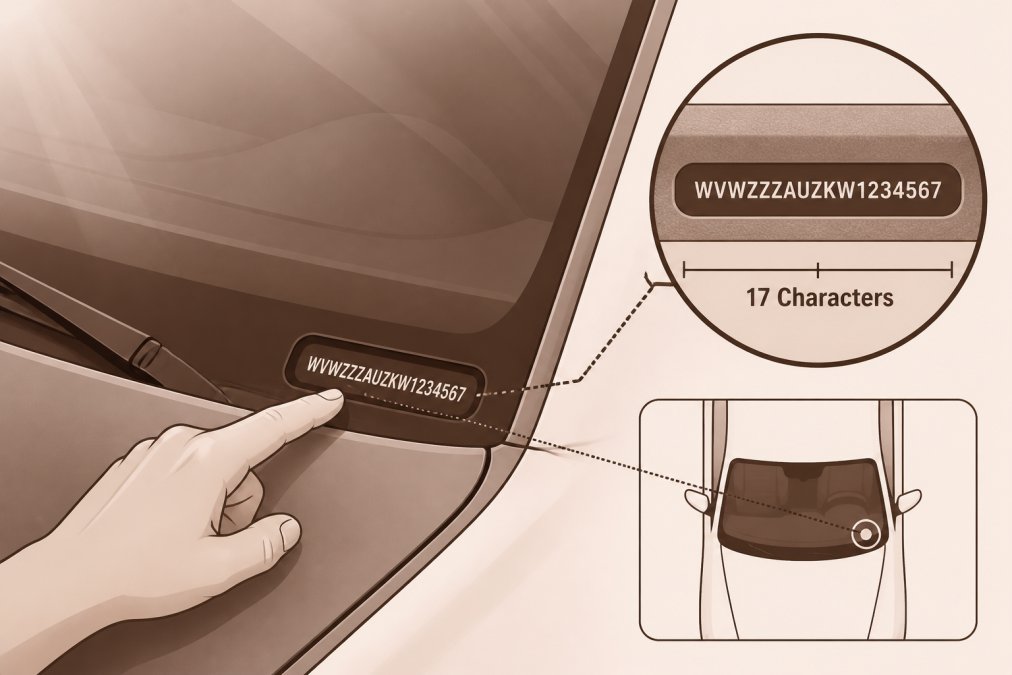
Every VIN lookup on a quality parts platform cross-references your chassis number against the manufacturer's parts catalog, eliminating guesswork from relying on make, model, and year alone.
Decoding the VIN: What Each Section Tells You
A standard 17-character VIN breaks into three functional sections:
- Characters 1-3 (World Manufacturer Identifier): Identifies the manufacturer and country of assembly. For VW Group vehicles, this distinguishes between German-assembled and Mexican-assembled units, affecting parts specifications.
- Characters 4-8 (Vehicle Descriptor Section): Encodes body style, engine code, and restraint system type, where most fitment-critical data lives.
- Characters 9-11 (Check digit + model year + plant code): The model year character is not always intuitive. A vehicle built in late 2014 for the 2015 model year carries a 2015 model year code, which matters when sourcing replacement parts.
- Characters 12-17 (Production sequence number): Used to track production date ranges and mid-run specification changes.
According to NHTSA's VIN decoder documentation, the standardized VIN format has been required on all vehicles sold in the United States since 1981, making it the definitive identifier for parts compatibility research.
Production Date Ranges and Why They Change Part Compatibility
Two cars with identical make, model, and year can require different parts if built in different production windows. VW Group manufacturers commonly implement engineering changes mid-production year. A suspension component may have been revised in March, meaning cars built before that date require the earlier specification and cars built after require the updated version. The production date is stamped on a label inside the driver's door jamb, separate from the model year encoded in the VIN.
Always cross-reference both the VIN and production date when sourcing fitment-critical components like suspension hardware, engine assemblies, and brake components.
OEM vs Aftermarket Parts for European Cars: Fitment Differences That Matter
OEM vs aftermarket parts for European cars is not simply a quality debate, it's a fitment debate. Genuine OEM components are manufactured to exact specifications documented in technical documentation. Aftermarket alternatives are manufactured to approximate those specifications, with deviation varying significantly by supplier.
For Audi, Porsche, and Volkswagen vehicles, the fitment gap can be meaningful. Brake pad thickness tolerances, sensor connector geometry, and mounting hardware thread pitch are areas where aftermarket parts occasionally deviate from factory spec, introducing long-term wear issues.
Cross-Referencing OEM Part Numbers Against Aftermarket Alternatives
OEM part number cross-referencing maps a manufacturer's original part number to an aftermarket supplier's equivalent catalog number, allowing verification that an aftermarket part was designed to replace a specific OEM component.
The process: (1) Identify the OEM part number from the vehicle's parts catalog or VIN-based lookup; (2) Search the aftermarket supplier's database using that OEM number; (3) Verify the cross-reference is direct, not a "fits also" approximation; (4) Check whether the aftermarket part supersedes an updated OEM number, indicating the original part was revised.
Example: the Audi Center Cap (part number 8W0-601-170) lists a replacement for part number 4M0601170. That supersession relationship is documented in the OEM catalog. An aftermarket cross-reference pointing to the original number but not the superseded one may deliver the wrong specification.

As documented in SAE International's technical standards for parts identification, standardization in part numbering across OEM and aftermarket suppliers remains an ongoing challenge for European vehicle platforms.
The Most Common European Parts Fitment Errors and How to Fix Them
Most fitment errors fall into predictable patterns:
| Fitment Error | Root Cause | Fix |
|---|---|---|
| Wrong brake pad specification | Year correct, engine code ignored | Confirm engine code via VIN character 5-8 |
| Sensor connector mismatch | Aftermarket cross-reference error | Verify OEM part number directly |
| Suspension component off by 2mm | Production date range not checked | Check door jamb production date label |
| Filter thread pitch wrong | Regional spec difference (US vs Euro) | Confirm left-hand drive US spec explicitly |
| Hardware kit incomplete | Assembly vs. component confusion | Order full assembly, not individual components |
Make, Model, and Year Are Not Enough
Make, model, and year define a broad category, not a specific build configuration. A 2018 Audi A4 was available with multiple engine variants, two transmission types, and different suspension configurations. Each requires different replacement parts.
Always add engine code and transmission type to your search criteria. The engine code is a three or four character identifier found on a sticker in the engine bay or service record, narrowing the parts catalog from dozens of matches to the exact specification your vehicle requires.
Engine Code and Transmission Type Mismatches
Engine code mismatches are the second most common fitment error, particularly for engine components, filters, and timing-related hardware. A 2.0 TFSI engine has been produced in multiple variants, each with different internal specifications and compatible components.
Transmission type mismatches most commonly affect clutch assemblies, transmission fluid specifications, and driveline hardware. Automatic and manual variants require entirely different component sets, and DSG variants add another layer of specificity.
How to Verify Part Compatibility Before You Order
Verifying part compatibility requires more than a year-make-model dropdown selection.
Step 1: Retrieve your full VIN from the driver's side dashboard or vehicle registration.
Step 2: Identify the production date on the label inside the driver's door jamb.
Step 3: Confirm your engine code from the engine bay sticker or service documentation.
Step 4: Run a VIN-based parts lookup that cross-references your VIN against the manufacturer's parts catalog.
Step 5: Verify the OEM part number matches the current supersession chain.
Step 6: Check for left-hand drive (LHD) specification. US-spec vehicles are left-hand drive, and some components differ between LHD and right-hand drive specifications.
Step 7: Contact technical support if uncertain, particularly for complex assemblies or older models.
Visual Inspection Techniques for Replacement Parts
Visual inspection of replacement parts before installation catches fitment and quality issues that documentation alone misses.
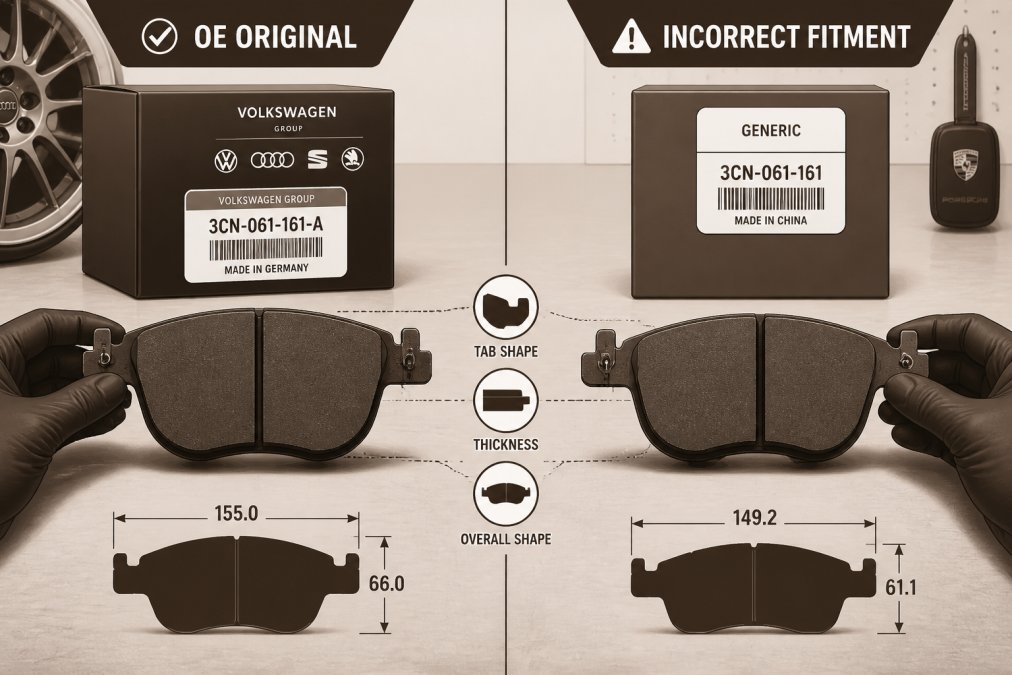
Place the new part alongside the old one and verify overall dimensions, mounting hole positions, and connector geometry match. A difference of even a few millimeters in a brake pad's backing plate width indicates a fitment problem.
Key visual inspection checkpoints:
- Part number label: Confirm the part number on the component matches the packaging number.
- Casting and machining quality: OEM components show consistent machining marks and surface finish. Counterfeits show uneven casting, rough edges, or inconsistent surface treatment.
- Hardware and fasteners: Verify all included hardware matches the thread pitch and head type specified in installation documentation.
- Connector and sensor geometry: For electronic components, verify connector housings, pin counts, and locking tabs match the vehicle harness exactly.
- Markings and certifications: Genuine OEM parts for the US market carry appropriate identification markings.
According to NHTSA's guidance on counterfeit auto parts, counterfeit automotive components pose documented safety risks, particularly in brake and steering systems. Visual inspection is your first line of defense.
Regional Spec Differences: Euro vs. US-Spec European Vehicles
Regional specification differences represent one of the most underappreciated sources of fitment errors. A vehicle sold in the United States may differ from its European-market counterpart in ways directly affecting parts compatibility.
Common specification differences include:
- Lighting assemblies: US federal motor vehicle safety standards require different headlight and taillight configurations than European regulations. Euro-spec lighting components will not fit US-spec housings.
- Emissions equipment: US-spec vehicles carry different catalytic converter configurations, oxygen sensor placements, and exhaust system specifications to meet EPA standards.
- Suspension tuning: Some models were offered with different spring rates and damper specifications for the US market.
- Bumper and impact systems: US-spec vehicles meet NHTSA impact standards, differing from European NCAP requirements. Bumper reinforcement bars and mounting hardware may differ accordingly.
Always confirm that the part you're ordering is specified for the US market, not the European domestic market. On a well-structured parts platform, VIN-based configuration automatically filters to the correct regional specification.
Spotting Counterfeit and Mismatched Parts Before Installation
Counterfeit and mismatched automotive components are a documented problem in the online parts market. For European vehicles, where genuine OEM parts carry a significant price premium, the incentive to produce convincing counterfeits is high.
The most reliable indicators of counterfeit or mismatched parts:
- Packaging inconsistencies: Genuine OEM packaging uses consistent fonts, color codes, and part number formats. Blurry printing or incorrect logo proportions are warning signs.
- Missing or incorrect part markings: Genuine OEM components carry manufacturer identification codes, production date stamps, and material markings.
- Weight and material differences: Counterfeit brake components often use inferior friction materials that are lighter than genuine parts.
- Price anomalies: Genuine OEM parts have established pricing. Substantial discounts below known OEM prices warrant verification of authenticity.
- Supplier verification: Purchase from suppliers who can document their supply chain.
According to the Automotive Anti-Counterfeiting Council's industry resources, counterfeit automotive parts are a multi-billion dollar problem globally, with brake components and filters among the most frequently counterfeited categories.
For genuine OEM components with verified part numbers, European OEM Parts stocks authentic Audi, Porsche, and Volkswagen components with full manufacturer traceability, including the Audi Wiper Blade set (part number 4M1-998-002) and the Audi Center Cap (part number 8W0-601-170), sourced directly through authorized channels.

Avoiding incorrect fitment for European parts ultimately comes down to systematic verification at every stage: VIN lookup, production date confirmation, OEM part number cross-reference, regional spec check, and visual inspection on arrival. Together, these steps eliminate the vast majority of fitment errors before they cost you time, money, or vehicle reliability.
Frequently Asked Questions
Why is VIN-based part lookup important for European vehicles?
European vehicles like Audi, Porsche, and Volkswagen often share body styles across multiple model years while using different internal components. A VIN encodes the exact production date, engine code, transmission type, and regional specification of your specific vehicle. Searching by make and model alone can return dozens of compatible-looking parts that will not physically fit or function correctly. Using the full VIN narrows results to components engineered for your exact chassis number and build configuration, dramatically reducing incorrect fitment and return rates.
How do I know if an aftermarket part will fit my European car?
Cross-reference the aftermarket part number against the OEM part number for your vehicle's VIN. Reputable aftermarket suppliers publish compatibility data, but tolerances and mounting hardware can differ from OEM specifications even when the part number cross-reference appears correct. For safety-critical assemblies like brakes or suspension components on Audi, Porsche, or Volkswagen vehicles, genuine OEM parts carry manufacturer-verified fitment data. Always confirm the engine code and production date range listed in the part's technical documentation before ordering.
Does 'OEM' always guarantee perfect fitment for European imports?
Genuine OEM parts guarantee fitment only when matched to the correct vehicle specification. A part manufactured by Audi or Porsche for a Euro-spec model may carry the same OEM part number as a US-spec version but differ in mounting points, wiring connectors, or emissions-related hardware. Verify that the part number corresponds to your vehicle's US-market build by confirming the chassis number and production date with your supplier before purchasing. Listings that say 'OEM equivalent' without a manufacturer part number are aftermarket products, not genuine OEM components.
What should I do if I receive an incorrectly fitted part?
Do not attempt to modify or force-fit the component. Document the part number on the packaging, photograph it next to the original component, and note any dimensional or mounting differences. Contact your supplier with your VIN, the part number you ordered, and the part number received. A supplier with genuine OEM inventory can cross-reference your VIN against the correct part number and arrange a replacement. Attempting to install a mismatched part on a European vehicle can cause diagnostic fault codes and may void manufacturer warranty coverage on related assemblies.
Sourcing European parts correctly is genuinely difficult without a reliable partner who understands the specificity these vehicles demand. European OEM Parts provides genuine Audi, Porsche, and Volkswagen components with exclusive pricing, fast nationwide shipping, and the technical expertise to help you identify the exact part your vehicle requires. Browse the catalog at European OEM Parts and get the right part the first time.
This article was written using GrandRanker