

Best Porsche Cayenne Engine Air Filters (2026)
Table of Contents
- What Makes a Great Porsche Cayenne Air Filter
- Top Porsche Cayenne Engine Air Filters Ranked
- OEM vs Aftermarket Air Filter Performance
- Porsche Cayenne Air Filter Replacement Interval Guide
- How to Change Your Porsche Cayenne Air Filter
- Fuel Economy and Engine Protection Impact
- Which Porsche Cayenne Air Filter Should You Buy?
- Conclusion
Last Updated: August 16, 2026
Picking the best Porsche Cayenne engine air filters carries real consequences for long-term engine health. A poorly fitting or low-efficiency filter lets particulate matter bypass the housing seal and reach the intake manifold, where abrasive dust accelerates wear on pistons, rings, and turbocharger internals. Below, we rank the top options, break down OEM versus aftermarket performance, and give you a complete replacement guide covering the 9PA, 92A, and PO536 chassis codes.
Quick Picks:
- Best Overall: Genuine Porsche OEM Paper Element Filter, factory filtration efficiency, guaranteed fit
- Best Value OEM Alternative: Mann or Mahle OEM-supplier replacement, identical media, lower price
- Best for Performance Builds: High-flow cotton gauze filter, improved airflow, suited to track or modified setups
- Best Synthetic Option: Synthetic media drop-in filter, extended service intervals, high dust capacity
What Makes a Great Porsche Cayenne Air Filter
A great Porsche Cayenne engine air filter removes particulate matter efficiently, seals perfectly against the airbox assembly, and maintains adequate airflow to support combustion efficiency.
Filtration Efficiency and Micron Ratings
Filtration efficiency is the percentage of airborne particles a filter captures at a given micron rating. For the Cayenne's turbocharged engines, this matters significantly. Turbocharger protection depends on stopping fine dust before it reaches the compressor wheel, where even microscopic abrasives cause cumulative damage.
OEM paper elements typically filter particles down to around 10 microns with high efficiency, the factory specification Porsche engineers designed the engine's tolerances around. High-flow cotton gauze filters offer slightly coarser filtration in exchange for reduced airflow restriction, a trade-off suited to modified engines but harder to justify on a stock daily driver. Synthetic media filters occupy the middle ground: they claim filtration efficiency comparable to paper with better dust capacity and longer service intervals.
If your Cayenne runs stock engine internals and sees mixed road and highway use, prioritize filtration efficiency over airflow gains. The fuel-air mixture improvements from a high-flow filter on a stock engine are marginal, while the risk of reduced turbocharger protection is not.
Housing Seal, Airbox Fit, and Chassis Code Compatibility
A filter that doesn't seal perfectly against the airbox assembly creates a bypass path for unfiltered air. This is the most common mistake with aftermarket drop-ins: the filter media may be excellent, but the rubber sealing lip doesn't match the exact geometry of the Cayenne's airbox.
Porsche Cayenne production spans three distinct generations with different chassis codes:
- 9PA (2003-2010): First-generation Cayenne, including the 3.2 V6, 4.5 V8, and Turbo variants
- 92A (2011-2017): Second generation, with 3.0 V6, 3.6 V6, 4.8 V8, and hybrid options
- PO536 (2018-present): Third generation, featuring the 3.0 V6 turbo across most trim levels
Always verify compatibility using your chassis code and model year before ordering.
Top Porsche Cayenne Engine Air Filters Ranked
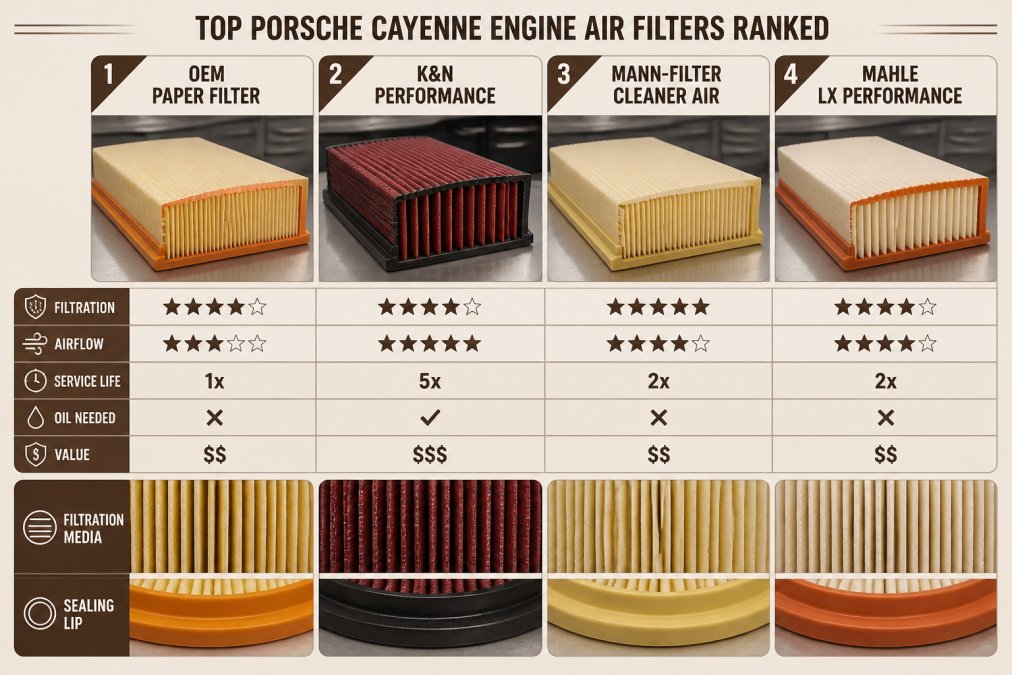
1. Genuine Porsche OEM Paper Element Filter
The genuine Porsche OEM paper element filter is the definitive benchmark. It's what the factory installed, what Porsche engineers validated against the intake manifold geometry, and what the engine management system was calibrated around.
The paper element uses layered synthetic-paper media with a pleated design that maximizes surface area within the airbox footprint. The housing seal matches the airbox assembly exactly because it was designed to.
Best for: Owners prioritizing warranty compliance, lease returns, or factory specifications.
The honest limitation: It's the most expensive filter option on a per-service basis and requires replacement rather than cleaning.
2. OEM Supplier-Grade Replacement Filter (Mann, Mahle)
Mann and Mahle manufacture filters for European automakers at the factory level. In many cases, the filter inside the Porsche-branded box and the Mann or Mahle equivalent come from the same production line with identical filtration media.
Filtration efficiency, airbox fit, and housing seal quality are equivalent to genuine Porsche OEM filters. The practical difference is price.
Best for: DIY maintenance owners who want OEM-equivalent performance without paying the Porsche parts counter premium.
3. High-Flow Cotton Gauze Performance Filter
High-flow cotton gauze filters use multiple layers of oiled cotton gauze over a wire mesh frame to reduce airflow restriction while maintaining acceptable filtration. The reduced restriction improves throttle response at high RPM and pairs well with cold air intake or aftermarket intake manifold modifications.
The real-world gains on an unmodified Cayenne are modest. This filter earns its place on track-day builds or vehicles with aftermarket intake upgrades, where the marginal airflow improvement compounds with other modifications.
The one drawback: Cotton gauze filters require periodic cleaning and re-oiling to maintain their rated filtration efficiency.
4. Synthetic Media Drop-In Filter
Synthetic media drop-in filters use non-woven synthetic fiber instead of paper or cotton gauze, offering high filtration efficiency and extended service intervals without the re-oiling requirement of cotton gauze.
The best synthetic media filters match OEM filtration efficiency at fine micron ratings while offering meaningfully higher dust capacity, making them well-suited to vehicles operated in dusty or high-particulate environments.
Best for: High-mileage Cayenne owners or those in arid, dusty climates who want to extend service intervals without sacrificing long-term engine health.
OEM vs Aftermarket Air Filter Performance
Filtration Efficiency Trade-Offs
OEM paper elements and OEM-supplier equivalents deliver consistent filtration efficiency across the filter's rated service life. High-flow aftermarket filters present a genuine trade-off: reduced airflow restriction means slightly coarser filtration. For a turbocharged engine, fine particulate matter that bypasses the filter reaches the compressor wheel directly, causing cumulative damage.
Synthetic media filters largely close this gap, offering filtration efficiency that approaches OEM paper while extending the service interval.
Warranty Compliance and Factory Specifications
Under the Magnuson-Moss Warranty Act guidelines, a manufacturer cannot void a vehicle warranty solely because an aftermarket part was used, unless they can demonstrate the aftermarket part caused the specific failure. However, Porsche dealers may scrutinize engine-related warranty claims more closely when non-OEM filtration is documented.
For vehicles under warranty or approaching a certified pre-owned inspection, stick with genuine Porsche OEM or OEM-supplier equivalents.
Porsche Cayenne Air Filter Replacement Interval Guide
The standard Porsche Cayenne air filter replacement interval is every 20,000 to 30,000 miles under normal operating conditions, or at every second annual service.
Climate-Specific Maintenance Adjustments
Climate and environment dramatically affect how quickly a filter reaches its dust capacity limit.
| Operating Environment | Recommended Inspection Interval | Recommended Replacement Interval |
|---|---|---|
| Urban highway (low dust) | 15,000 miles | 25,000-30,000 miles |
| Mixed city/highway | 12,000 miles | 20,000-25,000 miles |
| Arid/dusty (Southwest, desert) | 8,000 miles | 12,000-15,000 miles |
| Track use (high RPM, high intake) | Every event | 10,000 miles or annually |
| High humidity/coastal | 15,000 miles | 20,000-25,000 miles |
Owners in arid climates should treat these intervals as maximums, not targets.
Signs of a Clogged or Failing Air Filter
Recognizing a clogged air filter early prevents compounding damage:
- Reduced throttle response, particularly at low RPM from a standing start
- Noticeably increased fuel consumption over a consistent driving cycle
- Rough idle or hesitation under acceleration
- Black smoke from the exhaust (over-rich fuel-air mixture)
- Audible intake noise change
- Check engine light triggered by mass airflow sensor readings outside expected range
How to Change Your Porsche Cayenne Air Filter
Changing a Porsche Cayenne air filter is a straightforward DIY maintenance task on all three generations, typically completed in under 20 minutes.
Tools You'll Need
- Flathead screwdriver (for housing clips on 9PA and 92A)
- T25 Torx driver (PO536 generation airbox fasteners)
- Clean lint-free cloth
- Replacement filter (verified by chassis code and part number cross-reference)
No installation torque is required beyond hand-tight. Over-tightening the housing seal clips on the 92A can crack the plastic airbox housing.
Step-by-Step Installation (9PA, 92A, and PO536 Generations)
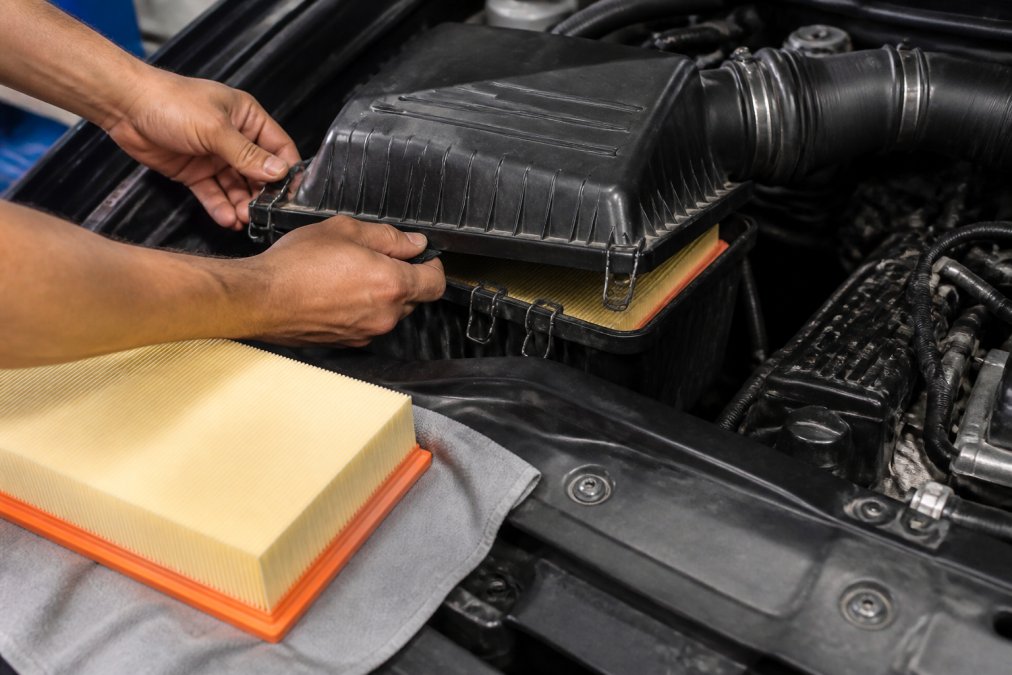
Step 1: Locate the airbox assembly. The airbox sits in the engine bay on the passenger side. The 9PA uses a larger rectangular housing; the 92A and PO536 use a more compact integrated assembly.
Step 2: Disengage the housing clips. The 9PA and 92A use spring-steel housing clips that release with a flathead screwdriver. The PO536 uses T25 Torx fasteners on the upper housing.
Step 3: Remove the intake ducting connection. On the 92A and PO536, a rubber intake duct connects the airbox to the throttle body. Loosen the hose clamp and slide the duct back before fully opening the airbox.
Step 4: Extract the old filter element. Lift the paper element straight out. Note the orientation of the filter media and the direction the housing seal faces.
Step 5: Clean the airbox interior. Wipe the inside of the airbox with a lint-free cloth to remove accumulated dust and debris.
Step 6: Install the new filter. Place the new filter with the housing seal facing the same direction as the original. Press the seal firmly against the airbox lip before closing the lid.
Step 7: Secure the housing. Re-engage all clips or Torx fasteners. Reconnect the intake ducting and verify the hose clamp is snug.
Fuel Economy and Engine Protection Impact
A severely restricted filter forces the engine management system to compensate for reduced airflow, often by enriching the fuel-air mixture beyond optimal combustion efficiency ratios. The result is measurably worse fuel economy and higher exhaust emissions.
For turbocharged Cayenne variants, restricted intake airflow reduces the pressure differential the turbocharger can develop, limiting boost pressure and reducing power output before any fault codes appear. Owners often attribute this gradual power loss to normal wear when the cause is a filter past its replacement interval.
Maintaining clean air intake filtration is one of the most cost-effective preventative maintenance measures for extending internal combustion engine life. For a Cayenne with a turbocharged engine, the cost of a replacement filter is a fraction of the cost of turbocharger repair or replacement caused by contaminated intake air.
Which Porsche Cayenne Air Filter Should You Buy?
For the majority of Cayenne owners doing routine preventative maintenance on a street-driven vehicle, the Mann or Mahle OEM-supplier grade filter is the best recommendation. It delivers OEM-equivalent filtration efficiency and housing seal quality at a lower price than the genuine Porsche part.
For owners who prioritize zero warranty risk or are preparing for a CPO inspection, the genuine Porsche OEM paper element is the correct choice.
For track-day builds or modified Cayennes with cold air intake systems, a high-flow cotton gauze or synthetic media filter makes sense, provided the maintenance schedule is followed.
For high-mileage vehicles in dusty climates, synthetic media is worth the premium for the extended service interval and superior dust capacity.
| Filter Type | Best For | Filtration Efficiency | Service Interval | Reusable |
|---|---|---|---|---|
| Genuine Porsche OEM | Warranty compliance, CPO prep | Highest (OEM spec) | 20,000-30,000 mi | No |
| Mann / Mahle OEM-supplier | DIY maintenance, best value | Equivalent to OEM | 20,000-30,000 mi | No |
| Cotton gauze high-flow | Modified/track builds | Slightly lower | Varies (clean/re-oil) | Yes |
| Synthetic media drop-in | Dusty climates, high mileage | Near-OEM | 30,000-50,000 mi | No |
Maintaining your Cayenne's engine air intake with the right filter is straightforward when you match the choice to your actual use case. EUROPEAN OEM PARTS stocks genuine Porsche OEM filters and OEM-supplier equivalents from Mann and Mahle across all Cayenne generations, with part number cross-reference verification and fast nationwide shipping. Get the right filter for your chassis code and keep your Cayenne's engine protected.
Frequently Asked Questions
How often should I replace the engine air filter on a Porsche Cayenne?
Porsche's factory service schedule generally recommends replacing the engine air filter every 20,000 to 30,000 miles, or roughly every two years, whichever comes first. If you drive in dusty, arid, or high-pollen environments, check it every 15,000 miles. A visibly gray or compacted filter element, reduced throttle response, or a drop in fuel economy are all signs the filter is due for replacement ahead of schedule.
Does an aftermarket air filter void my Porsche factory warranty?
Under the Magnuson-Moss Warranty Act, a dealer cannot void your warranty simply because you installed an aftermarket part, they must prove the aftermarket filter directly caused the failure. That said, using a genuine OEM or OEM-supplier replacement eliminates any ambiguity. For leased vehicles or Cayennes still under the Porsche factory warranty, a genuine OEM filter is the safest choice to keep warranty compliance clean and avoid disputes at the dealership.
Is it worth upgrading to a high-flow air filter for my Cayenne?
For daily driving, the gains from a high-flow cotton gauze or cold air intake filter are modest, most owners report minimal horsepower changes on a stock Cayenne. The real benefit shows up on turbocharged models where reducing airflow restriction can support better combustion efficiency and slightly improved throttle response. If your Cayenne is tuned or sees track use, a high-flow drop-in filter makes more sense. For stock engines, a quality OEM replacement delivers reliable long-term engine health without trade-offs in filtration efficiency.
What is the difference between OEM and performance air filters?
A genuine OEM paper element filter is engineered to Porsche's factory specifications, balancing particulate matter capture, dust capacity, and airflow restriction for a stock engine. Performance filters, typically cotton gauze or synthetic media, prioritize airflow over fine filtration, which can improve throttle response but may allow smaller particles through. OEM filters offer tighter micron ratings suited for long-term engine protection. Performance filters require regular cleaning and re-oiling to maintain their filtration efficiency, adding to ongoing maintenance time.
How do I find the right air filter part number for my Cayenne model year?
The safest method is to use your vehicle's chassis code and model year together when searching for a replacement. Porsche Cayenne generations, 9PA (2003-2010), 92A (2011-2018), and PO536 (2019-present), each use different airbox assemblies and filter dimensions. Cross-reference the OEM part number printed on your existing filter against a verified part number catalog, or contact a specialist supplier who can confirm fitment by VIN to avoid returns.
This article was written using GrandRanker