

How to Verify Genuine Audi Parts: A 2026 Guide
Table of Contents
- What 'Genuine Audi Parts' Actually Means
- Step 1, Use Your 17-Digit VIN to Confirm Fitment
- How to Check Audi Part Numbers for Authenticity
- Visual Inspection: Packaging, Branding, and Markings
- Authorized Audi Parts Dealers vs. Online Aftermarket Sources
- Digital Verification Tools and Online Catalog Search
- Factory Warranty Protection and Why It Depends on Genuine Parts
- Conclusion
Last Updated: August 16, 2026
What 'Genuine Audi Parts' Actually Means
Genuine Audi parts are components manufactured to Volkswagen Group factory specifications, supplied through Audi's authorized distribution network, and sold with full manufacturer backing. A part that looks correct and fits the mounting points can still fail prematurely if it wasn't built to the same material tolerances, heat ratings, or dimensional specifications as the factory original. The consequences range from accelerated wear to voided warranties, and in the case of brake or suspension components, genuine safety implications.
OEM, Genuine, and Aftermarket: The Real Differences
Genuine Audi parts are manufactured by Audi or its Volkswagen Group-approved suppliers, packaged under the Audi or VW Group brand, and distributed through authorized channels. They carry the full factory warranty and are identical to what came on your vehicle at the assembly plant.
OEM parts stands for Original Equipment Manufacturer, meaning the component was made by the same supplier that produced parts for the factory line, but it may be sold without Audi branding. Many Audi suppliers, such as Bosch, Sachs, or Mahle, sell their components directly to the aftermarket. These are functionally equivalent to genuine parts but arrive in the supplier's own packaging.
Aftermarket parts are produced by third-party manufacturers with no factory relationship. Quality varies enormously. Some aftermarket suppliers produce components that meet or exceed OEM specifications; others cut corners on materials or tolerances. Without factory quality assurance controls, you're relying entirely on the aftermarket brand's reputation.
For warranty protection and confirmed fitment, genuine parts are the safest choice. OEM supplier parts from verified brands are a credible alternative. Generic aftermarket, particularly at suspiciously low price points, carries real risk.
| Category | Manufacturer | Packaging | Factory Warranty | Risk Level |
|---|---|---|---|---|
| Genuine Audi | VW Group / approved supplier | Audi-branded box | Full coverage | Lowest |
| OEM Supplier | Original factory supplier | Supplier branding | Limited | Low |
| Aftermarket (reputable) | Third-party | Varies | None from Audi | Medium |
| Counterfeit | Unknown | Fake Audi branding | None | Highest |
Step 1: Use Your 17-Digit VIN to Confirm Fitment
The single most reliable way to verify that a part is correct for your specific vehicle is to use your 17-digit VIN. Every Audi produced for the US market carries a unique VIN that encodes the model year, production plant, engine code, transmission type, and build sheet configuration. A part that fits a 2015 A4 with a 2.0T quattro may not fit the same model year with a different drivetrain.
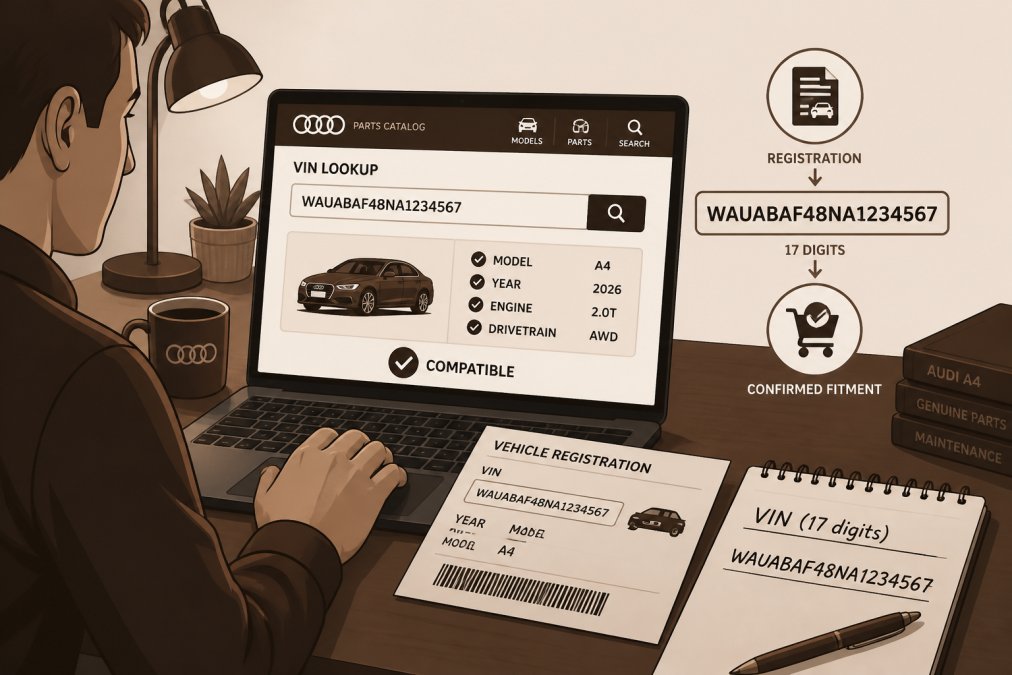
Your VIN is located on the driver's side dashboard, visible through the windshield, and also appears on your title, registration, and insurance documents. Enter it into any official Audi parts catalog or VIN-based fitment tool before placing an order. This cross-reference step catches compatibility issues that a simple year/make/model search misses.
According to Audi's official parts and accessories portal, VIN-based catalog searches return results specific to your exact build configuration, not just your model line.
If a supplier's catalog doesn't support VIN-based lookup, that signals limited technical infrastructure. Reputable distributors build VIN compatibility into their ordering process because fitment accuracy is non-negotiable for genuine replacement parts.
How to Check Audi Part Numbers for Authenticity
Every genuine Audi component carries a standardized part number that follows Volkswagen Group's internal numbering convention. These encode the vehicle group, component category, and specific application, and they're the same numbers you'll find in Audi's official ETKA parts catalog.
Cross-Referencing Part Numbers Against Official Catalogs
Locate the part number printed on the component itself or its packaging, then cross-reference it against the Volkswagen Group's ETKA electronic parts catalog or an authorized dealer's catalog system. Genuine parts will return an exact match with full technical specifications, assembly diagrams, and supersession history.
Pay attention to supersession. Audi regularly updates part numbers when a component is revised. A legitimate part may carry a different number than older documentation, but the catalog will show the supersession chain. If a seller is offering an "original" part with a number that doesn't appear in any catalog, that's a red flag.
A common mistake is relying solely on the box label rather than checking the component itself. Counterfeit operations frequently repackage inferior components in copied Audi packaging while the part inside carries no legitimate part number at all.
Visual Inspection: Packaging, Branding, and Markings
Visual inspection is your first line of defense. Genuine Audi parts come in packaging that reflects Volkswagen Group's quality standards. The boxes are sturdy, the printing is sharp and consistent, and the branding follows strict corporate guidelines.
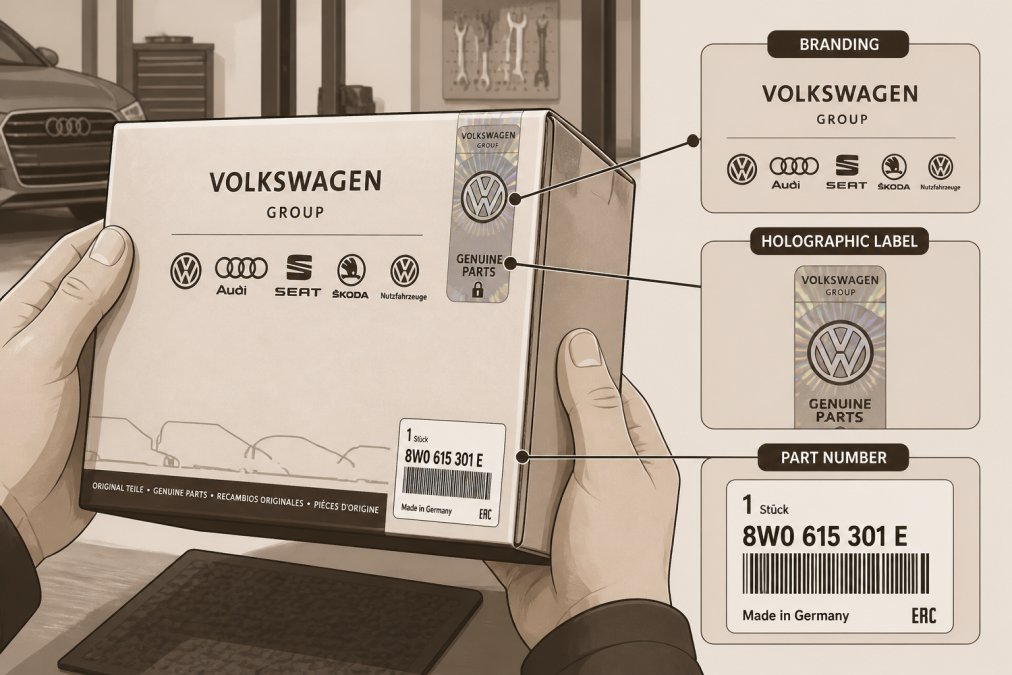
Volkswagen Group Standardized Markings to Look For
When inspecting packaging, look for:
- The Audi four-ring logo printed with clean, precise edges and consistent color saturation
- A standardized part number in the Volkswagen Group format, printed clearly on multiple faces of the box
- Country of origin and manufacturing facility markings, typically referencing Germany or an authorized production site
- Volkswagen Group AG branding on the box itself, often alongside the Audi brand
- Holographic security labels on higher-value components such as engine, brake, and transmission parts
- Batch codes and date stamps that follow a consistent format
The component itself should also carry markings. Brake pads will have the friction material grade stamped into the pad. Filters will have the OEM supplier's part number molded into the housing. If the hardware is completely unmarked, treat it as suspect.
Price-Point Red Flags and Counterfeit Packaging Signs
Genuine Audi parts have fixed costs tied to factory production, quality assurance, and authorized distribution. A listing offering a genuine Audi timing chain kit or turbocharger at a fraction of typical authorized dealer pricing isn't a deal, it's a signal that something in the supply chain is wrong.
Specific packaging red flags include:
- Blurry or pixelated logo printing
- Inconsistent font weights across the box
- Spelling errors or grammatical inconsistencies in technical descriptions
- Packaging that feels lightweight or flimsy
- Missing or poorly applied holographic labels
- No batch code, date stamp, or country of origin
As documented in the National Highway Traffic Safety Administration's guidance on counterfeit auto parts, counterfeit automotive components present genuine safety risks and are increasingly difficult to distinguish from authentic parts without careful inspection.
Authorized Audi Parts Dealers vs. Online Aftermarket Sources
Authorized dealerships source directly from Audi's authorized distribution network, and their parts come with full Audi backing. The practical limitation is cost and convenience. Dealership parts departments carry a markup that reflects their overhead, and availability for older or less common models can be inconsistent.
Reputable online aftermarket sources that specialize in Volkswagen Group vehicles can offer genuine parts at more competitive pricing, with broader catalog depth for older models. The key differentiator is sourcing transparency. A trustworthy online supplier will tell you exactly where their parts come from, provide part numbers that cross-reference against official catalogs, and support VIN-based fitment verification.
European OEM Parts provides genuine OEM components for Audi, Porsche, and Volkswagen applications, including older and harder-to-source models, with VIN-based fitment verification built into the ordering process.
Return Policy and Warranty as Trust Signals
A supplier's return policy tells you more about their confidence in their parts than any marketing copy. Authorized dealers and reputable online specialists will accept returns on unused, correctly ordered parts without creating unnecessary friction. A supplier that makes returns difficult or charges restocking fees is signaling that their parts quality or catalog accuracy isn't something they want to stand behind.
For warranty purposes, genuine Audi parts carry Volkswagen Group's factory warranty. If you're maintaining a leased vehicle or a car still under the manufacturer's limited warranty, using non-genuine parts for repairs can create complications with warranty claims. The Federal Trade Commission's guidance on the Magnuson-Moss Warranty Act clarifies that a manufacturer cannot void your entire vehicle warranty simply because you used a non-OEM part, but they can deny coverage for damage directly caused by that part.
Digital Verification Tools and Online Catalog Search
VIN decoders are widely available and free to use. Enter your 17-digit VIN into an official Audi or Volkswagen Group catalog tool, and the system returns your vehicle's exact build configuration, including engine code, transmission variant, and factory-fitted options.
Cross-referencing part numbers across multiple catalog systems adds another verification layer. If a part number returns consistent results across the official ETKA database, an authorized dealer's system, and a reputable specialist catalog, you have strong confirmation of authenticity. Discrepancies between catalogs, or a number that returns no results at all, warrant further investigation before purchasing.
Some Volkswagen Group component suppliers have introduced batch verification tools accessible via QR codes on packaging. Scanning the code connects to the supplier's authentication database and confirms the batch number is legitimate. This is most common on high-value components like fuel injectors, turbochargers, and ABS modules.
Factory Warranty Protection and Why It Depends on Genuine Parts
Factory warranty protection for genuine Audi parts is a concrete financial consideration. When a component fails within the warranty period, Audi covers the replacement cost. That coverage is tied to the part being a genuine Audi component sourced through authorized channels.
This matters most for high-cost assemblies: turbos, fuel injection systems, transmission components, and engine internals. These are also the categories most targeted by counterfeit operations, because the margin on a convincing fake is highest where genuine pricing is highest. A counterfeit turbocharger that fails six months after installation leaves you with no recourse and a significant repair bill.
For owners maintaining vehicles under an extended warranty or a certified pre-owned program, keeping records of part numbers, purchase receipts from authorized or reputable specialist sources, and installation dates creates a paper trail that supports warranty claims if a dispute arises. As outlined in the Magnuson-Moss Warranty Act documentation from the FTC, warranty terms must be clearly disclosed, and understanding your rights as a consumer protects you from improper warranty denials.
The replacement cycle for genuine parts also tends to be longer than for aftermarket alternatives, particularly for wear items like brake pads, filters, and suspension bushings.
Verifying genuine Audi parts requires more than checking the box. Counterfeit components have become sophisticated enough that visual inspection alone isn't sufficient, and a mismatched part number can be the difference between a repair that holds and one that fails. European OEM Parts provides genuine OEM components for Audi, Porsche, and Volkswagen vehicles with VIN-based fitment verification, accurate catalog search, and fast nationwide shipping. Get started with European OEM Parts and order with confidence that your vehicle receives the authentic components it was built to run on.
Frequently Asked Questions
What is the difference between OEM and genuine Audi parts?
OEM (Original Equipment Manufacturer) parts are produced by the same supplier that made the component for Audi's assembly line, but they may be sold without Audi branding. Genuine Audi parts carry the official Audi or Volkswagen Group label, come in branded packaging, and include factory warranty coverage. Both originate from the same supply chain, but genuine parts provide the clearest paper trail for warranty claims and authenticity verification.
How do I identify genuine Audi parts using a part number?
Every genuine Audi part carries a standardized part number, typically an 11-character alphanumeric code. Cross-reference that number against the official Audi online catalog or an authorized dealer's system using your 17-digit VIN. If the number on the part or packaging does not match what the catalog lists for your specific vehicle's build sheet, the part may be mislabeled, a poor fitment substitute, or counterfeit. Always verify before installation.
Are aftermarket parts as good as genuine Audi parts?
Aftermarket parts vary widely in quality. Some reputable aftermarket manufacturers meet or approach OEM specifications, but they are not produced to Volkswagen Group's exact technical specifications and do not carry the factory warranty. For components where precision matters most, brakes, engine assemblies, suspension hardware, genuine parts eliminate the uncertainty. Aftermarket options may suit lower-stakes replacement cycles, but they carry more fitment and quality assurance risk.
How can I tell if an Audi part is counterfeit?
Check the packaging for crisp, consistent Audi or Volkswagen Group branding, a verifiable part number, and a factory warranty card. Counterfeit parts often have blurry logos, inconsistent fonts, missing Volkswagen Group markings, or no QR code or holographic seal. A price significantly below the authorized dealer's catalog price is a strong red flag. Always buy from authorized dealers or verified distributors, and confirm the part number matches your VIN-specific catalog entry.
This article was written using GrandRanker