

Is DIY Porsche Spark Plug Replacement Worth It?
Table of Contents
- Porsche Spark Plug Replacement Cost: DIY vs. Dealership
- Tools Needed for a Porsche Spark Plug Change
- How Long Does a Porsche Spark Plug Change Take?
- Model-by-Model Difficulty: Which Porsches Are DIY-Friendly?
- Risks of Improper Installation: Torque, Threads, and Warranty
- When to Replace Ignition Coils and Plugs
- Post-Installation Diagnostic Checks
- Conclusion: Is DIY Porsche Spark Plug Replacement Worth It?
- Frequently Asked Questions
Last Updated: September 16, 2026
Porsche Spark Plug Replacement Cost: DIY vs. Dealership
Whether DIY Porsche spark plug replacement is worth it comes down to one variable most owners never calculate: your own time. Parts for a boxer engine are inexpensive relative to dealership labor, but the job ranges from a 90-minute driveway task on some models to a partial engine-drop on others. This guide from EUROPEAN OEM PARTS breaks down real costs, tool requirements, model-specific difficulty, and the torque and thread risks that turn a simple tune-up into an expensive repair.
Dealership pricing depends on your model's engine bay layout, and labor hours are billed accordingly. Because we don't publish shop rates, call your local dealer for a written estimate before you decide.
What Dealerships Charge
Dealership quotes bundle parts, labor, and shop supplies into one figure, and that figure scales with how buried the plugs are. On a 911 or Boxster, the rear engine bay and surrounding components add hours of disassembly. On a front-engine Macan or Cayenne, access is far quicker.
Two cost drivers matter more than the hourly rate. First, whether the service writer bundles the job with a scheduled service interval. Second, whether ignition coils get replaced at the same time, which adds parts cost but eliminates a second labor charge later. Always ask for the quote itemized by labor hours and parts so you can compare it against doing the work yourself.
What DIY Parts and Tools Actually Cost
DIY parts pricing depends on whether you choose OEM parts or aftermarket alternatives, and your total depends on how much of the tool list you already own. Six plugs for a flat-six is a modest parts outlay. A torque wrench, socket extension, and the correct spark plug socket are the real variables.
Tools Needed for a Porsche Spark Plug Change
The tools needed for a Porsche spark plug change are minimal, but the wrong socket costs you a broken ceramic insulator. You need a 3/8-inch torque wrench, a spark plug socket in the correct size for your engine, a socket extension, a ratchet, dielectric grease, and an OBDII scanner for post-installation checks.
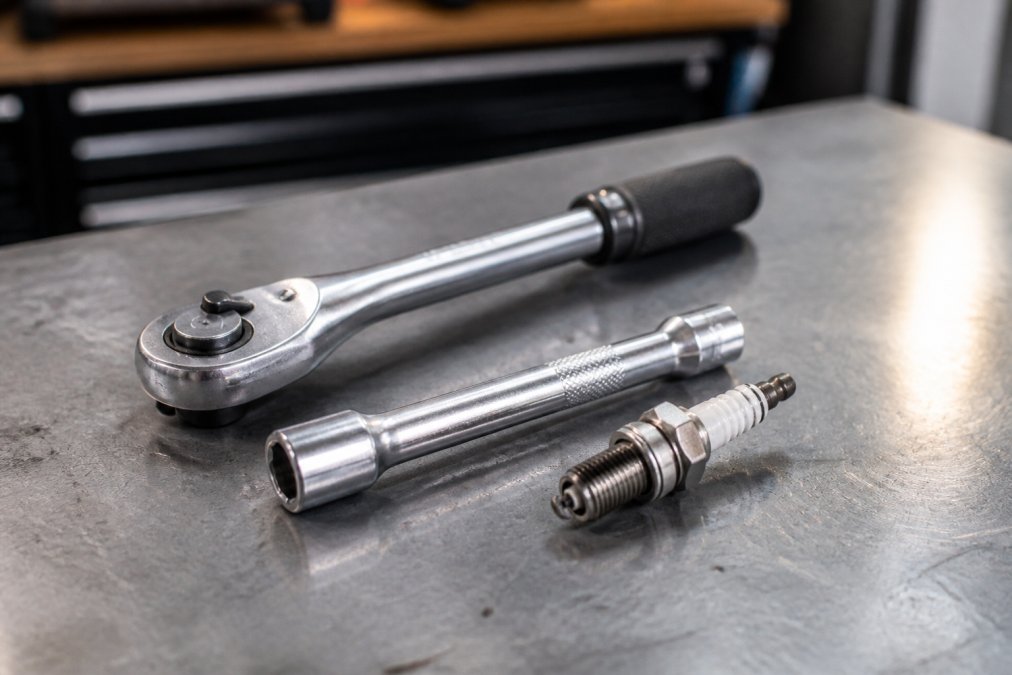
A few of these deserve emphasis. The torque wrench is not optional, and we'll explain why in the risks section. Dielectric grease goes on the coil boot, never on the threads. Anti-seize compound is a debated topic among technicians; follow your service manual rather than forum habit, because modern plug coatings often make it unnecessary.
Rent vs. Buy: Tool ROI for a One-Time Job
If you only plan to change plugs once, renting a torque wrench from an auto parts store is the cheaper path. If you own the car long-term, buying makes sense because you'll reuse the wrench for oil changes, brake work, and suspension jobs. A quality torque wrench is a lifetime tool, and a cheap one that drifts out of calibration is worse than no wrench at all.
How Long Does a Porsche Spark Plug Change Take?
A Porsche spark plug change takes roughly 90 minutes to two hours on a front-engine model and three to five hours on a rear-engine 911 or mid-engine Boxster, assuming no seized fasteners. Add time if you're removing access panels for the first time or working without a lift.
The variance comes almost entirely from engine bay access. Front-engine models give you a straight shot at the cylinder head. Rear-engine models require removing intake plumbing, and on some variants, the job is genuinely easier with the engine partially lowered. First-timers should budget double their estimate.
Model-by-Model Difficulty: Which Porsches Are DIY-Friendly?
Difficulty tracks engine placement and engine configuration, not model prestige. The table below is the model-specific accessibility matrix most guides skip: it names the actual obstacle you'll hit, not just a difficulty label. Times assume hand tools, no lift, and no seized fasteners.
| Model / Generation | Engine Placement | Primary Access Obstacle | DIY Difficulty | Typical Time |
|---|---|---|---|---|
| Macan (all) | Front | Coil-on-plug under engine cover; short reach | Easy | 1.5-2 hours |
| Cayenne (958, 9YA) | Front | Engine cover and intake ducting on V6/V8 | Easy-Moderate | 2-3 hours |
| 944, 968 | Front | Distributor-era layout; generous bay | Easy | 1.5-2 hours |
| Boxster / Cayman (986, 987) | Mid | Rear bulkhead access panel; plugs reachable from above and below | Moderate | 2.5-4 hours |
| Boxster / Cayman (981, 982) | Mid | Rear bulkhead panel plus partial intake removal | Moderate | 3-4 hours |
| 911 (996, 997) | Rear | Intake plenum and heat shields; plugs sit low and forward | Hard | 3-5 hours |
| 911 (991, 992) | Rear | Dense intake and turbo plumbing on turbo variants | Hard | 4-6 hours |
Three patterns explain almost all of the variance.
Front-engine models put the cylinder head in front of you. The only real work is removing the engine cover and, on V-configurations, the intake ducting that crosses over the coil packs. This is where a first-timer can genuinely succeed.
Mid-engine models split the difference. The rear bulkhead access panel gets you to the top of the engine, but the rear bank of cylinders is easier to reach from underneath. Owners who don't have a lift often find the job takes longer than the table suggests because they're working around the car rather than over it.
Rear-engine 911s are the hard case, and the reason is mechanical, not mystical. The engine sits where you'd normally stand, so the intake plenum, heat shields, and on turbo cars the charge piping all have to come off before a single plug is visible. On some variants, the job is genuinely easier with the engine partially lowered, which is a dealer-or-specialist job, not a driveway job. If your 911 is a turbo, budget the top of the time range and assume you'll need a second set of hands for the intake reinstall.
A quick self-assessment before you commit: if your model is front-engine, you can do this. If it's mid-engine and you own a floor jack and stands, you can do this with patience. If it's a rear-engine 911, especially a turbo, the honest answer is that the labor savings are real but the access risk is too, and a specialist who has done the job dozens of times will finish it in a fraction of your first-attempt time.
Risks of Improper Installation: Torque, Threads, and Warranty
The single biggest risk is over-torquing. Spark plugs seat into an aluminum cylinder head, and aluminum threads strip far more easily than the steel plug threads. An over-tightened plug can pull threads out of the head, turning a routine job into a head-off repair.
Under-torquing is the quieter failure.
When to Replace Ignition Coils and Plugs
Replace ignition coils when you replace plugs if the coils have significant mileage, or immediately if you see misfire codes, rough cold start, or reduced fuel efficiency. Plugs and coils wear together, and the coils live directly above the plugs.
Post-Installation Diagnostic Checks
Post-installation checks catch problems before they become expensive. Connect an OBDII scanner, clear any stored codes, and take the car for a short drive to confirm no new misfire codes appear.
Conclusion: Is DIY Porsche Spark Plug Replacement Worth It?
So, is DIY Porsche spark plug replacement worth it? On a front-engine Macan or Cayenne, yes, the savings are real and the job is genuinely beginner-friendly. On a rear-engine 911, it depends on your comfort level with intake disassembly and your tolerance for a half-day under the car. Either way, using genuine OEM parts protects your engine and your warranty.
Frequently Asked Questions
How much does Porsche charge to change spark plugs?
Dealership pricing varies by model and location, but Porsche spark plug replacement cost typically includes several hours of labor at dealer rates plus OEM parts. For a precise figure on your model, request a quote from your local dealership. Many owners compare that quote against the cost of genuine OEM parts from a trusted online supplier to see the potential savings before deciding whether to tackle the job themselves.
Is it worth it to change your own spark plugs on a high-performance engine?
It depends on your model and comfort level. On mid-engine and rear-engine Porsches, access to the cylinder head often requires removing engine bay panels or even dropping the engine, which pushes the job beyond typical DIY territory. On front-engine models like the Cayenne or Panamera, access is more straightforward. If you have the right tools, a torque wrench, and a service manual, DIY can save money on labor.
What specialized tools are required for a Porsche spark plug DIY?
You will need a torque wrench, a spark plug socket with a swivel or extension, dielectric grease, and an OBDII scanner for post-installation checks. Some models require wobble extensions or access panels to reach the cylinder head. A service manual for your specific model is essential. If you only plan to do this job once, renting specialized tools can be more cost-effective than buying them outright.
What are the risks of improper spark plug installation in a Porsche?
Over-torquing can strip the cylinder head threads, while under-torquing can cause a plug to back out and damage the engine. Incorrect gap or a fouled plug can lead to misfire, rough cold start, and reduced fuel efficiency. On models under warranty, improper installation may void coverage. Always follow the torque specification in your service manual and use anti-seize compound only if the manufacturer recommends it.