

5 Best Engine Oils for High Mileage Audi
Table of Contents
- Why High Mileage Audi Engines Need Specialized Oil
- Understanding Audi VW 502 00 Oil Specification
- How Often to Change Oil in High Mileage Audi
- Signs of Oil Consumption in Audi Engines
- 5 Best Engine Oils for High Mileage Audi: Comparison and Selection
- Synthetic vs. Synthetic Blend for Older Audi Engines
- Frequently Asked Questions
Last Updated: September 20, 2026
Why High Mileage Audi Engines Need Specialized Oil
High mileage Audi engines face unique challenges: widened tolerances, degraded seals, and combustion byproduct accumulation. This is where the 5 best engine oils for high mileage Audi become essential.
Turbocharged direct-injection engines compound the challenge: turbochargers generate extreme heat and pressure while direct injection creates higher combustion temperatures and soot production. Standard oils break down under these conditions, leaving varnish and sludge that accelerates wear.
Audi engines demand strict adherence to manufacturer specifications. Genuine Audi-approved oils contain specific additive packages engineered for VW Group architecture, the difference is engineering, not marketing.
Understanding Audi VW 502 00 Oil Specification
The VW 502.00 specification represents Audi's baseline requirement for synthetic engine oils, defining viscosity, thermal stability, oxidation resistance, and friction modifier content. Understanding why these standards exist is critical for protecting a high-mileage turbocharged engine.
What VW 502.00 Actually Tests
VW 502.00 is not a marketing designation; it is a rigorous testing protocol that measures:
Oxidation Stability (TOST Test): The oil is heated to 100°C for 1,000 hours. Approved oils resist sludge formation far better than non-approved synthetics. Sludge accelerates wear on piston rings, valve lifters, and turbo bearings. Non-approved oils may pass API SN ratings yet fail VW's more aggressive oxidation test.
Viscosity Index (VI) and Shear Stability: The oil must maintain its viscosity grade across the full operating temperature range. At 250°F, a VW 502.00 oil maintains its rated viscosity; non-approved synthetics thin excessively, reducing film strength when turbo bearings need protection most.
Friction Modifier Content: VW 502.00 oils contain specific friction modifiers that reduce drag on piston rings and valve train components, slowing oil consumption in worn engines. Generic high-mileage oils may lack the concentration or chemistry VW specifies.
Detergent and Dispersant Packages: Direct-injection Audi engines produce soot at higher rates than port-injection engines. VW 502.00 approval requires detergent packages that suspend soot and prevent varnish buildup. Non-approved oils may lack sufficient detergency for turbocharged direct-injection soot loads.
Why VW 502.00 Matters for Warranty and Turbo Protection
Using a non-approved oil voids warranty coverage and risks turbocharger failure. Turbo bearings depend on oil film strength and thermal stability, where Audi approvals make a measurable difference.
Turbo bearings rely on a thin oil film to separate metal surfaces spinning at 100,000+ RPM. If viscosity drops under heat or varnish accumulates, the film breaks down and bearing material sheds into the oil. Failure is rapid, often within 500-1,000 miles.
Audi's warranty explicitly requires VW-approved oils. Non-approved synthetics, even if API SN Plus certified, are insufficient. The approval is the contract.
VW 502.00 vs. VW 504.00: Which Does Your Engine Need?
Some newer Audi engines require VW 504.00, which adds stricter requirements around shear strength and long-drain capability for extended service intervals (up to 15,000 miles).
Check your owner's manual to determine which specification your vehicle requires. Using 502.00 oil in a 504.00-required engine is acceptable, but the reverse is unnecessary and more expensive. Non-approved oils leave you unprotected.
For high-mileage vehicles, always use the oil your manual specifies. The approval exists because Audi engineers tested that formulation against your engine's failure modes.
How to Verify Approval on the Bottle
Legitimate VW 502.00 or 504.00 approved oils display the approval code on the bottle label. Look for "VW 502.00" or "Meets VW 502.00 specification." Marketing language like "suitable for Audi" is not the same as official approval.
You can verify approval by:
- Checking the manufacturer's website (Mobil, Castrol, Shell, Valvoline, Liqui Moly all publish lists of approved products)
- Contacting the oil brand's customer service with your oil's product code
- Consulting your Audi dealer's parts department, which maintains an approved oil list
Oil Analysis as a Diagnostic Tool for Approval Validation
A used oil analysis (UOA) from a professional lab provides objective evidence that the oil is protecting your engine. A UOA measures iron content (piston ring wear), copper and tin (turbo bearing wear), viscosity retention, and oxidation resistance. These metrics reveal whether the oil is protecting your engine or whether internal wear is accelerating.
A baseline UOA after your first oil change on an approved oil gives you a reference point. Subsequent analyses reveal whether the oil is protecting your engine or whether internal wear is accelerating. If iron content is climbing or turbo bearing metals are present, you may need to shorten your oil change interval or address a mechanical issue.
How Often to Change Oil in High Mileage Audi
Oil change intervals for high mileage Audi engines depend on several factors: engine design, driving conditions, and the oil type you're using.
Most modern Audis can go 10,000 miles between synthetic oil changes, though some extend to 15,000 miles. High mileage vehicles benefit from 7,500-mile intervals once engines exceed 120,000 miles, as aging engines accumulate contaminants more quickly.
Turbocharged engines should use shorter intervals. Turbochargers generate soot at higher rates, and frequent changes reduce soot accumulation and protect turbo bearings.
Stop-and-go city driving creates more contaminants than highway miles. If most of your driving is urban, consider 5,000-7,500 mile intervals.
Signs of Oil Consumption in Audi Engines
Oil consumption becomes noticeable in high mileage Audi engines, and understanding what you're seeing, especially in turbocharged models, helps you respond before catastrophic failure occurs.
Turbocharger-Specific Oil Consumption Patterns
Turbocharged Audi engines exhibit distinct consumption patterns. Turbochargers operate at 200-250°F, causing faster oil degradation in the turbo housing. Worn turbo seals allow oil to escape into the exhaust at rates far exceeding normal piston ring blow-by.
Blue or Gray Smoke from the Exhaust
Blue or gray smoke from the exhaust indicates oil burning in the combustion chamber. In naturally aspirated engines, this happens when piston rings no longer seal tightly, allowing oil to slip past into the cylinders. In turbocharged engines, the source is often the turbocharger itself, oil escaping from worn seals and being burned in the exhaust gas stream.
Visible Oil Leaks and Seal Degradation
Visible oil leaks around valve covers, pan gaskets, and turbo seals indicate aging gaskets. Turbo oil return line cracks allow oil to spray onto the exhaust manifold, creating smoke without necessarily indicating internal wear.
Oil Level Dropping Faster Than Expected
Oil level dropping faster than expected warrants immediate attention. Check for leaks first, then inspect the turbo oil return line. If consuming oil internally, switch to high-mileage formulation with strong seal conditioners and monitor weekly.
5 Best Engine Oils for High Mileage Audi: Comparison and Selection
Selecting the right oil requires understanding what separates adequate protection from genuine Audi-specific excellence. The following represent the top choices for high mileage engines.
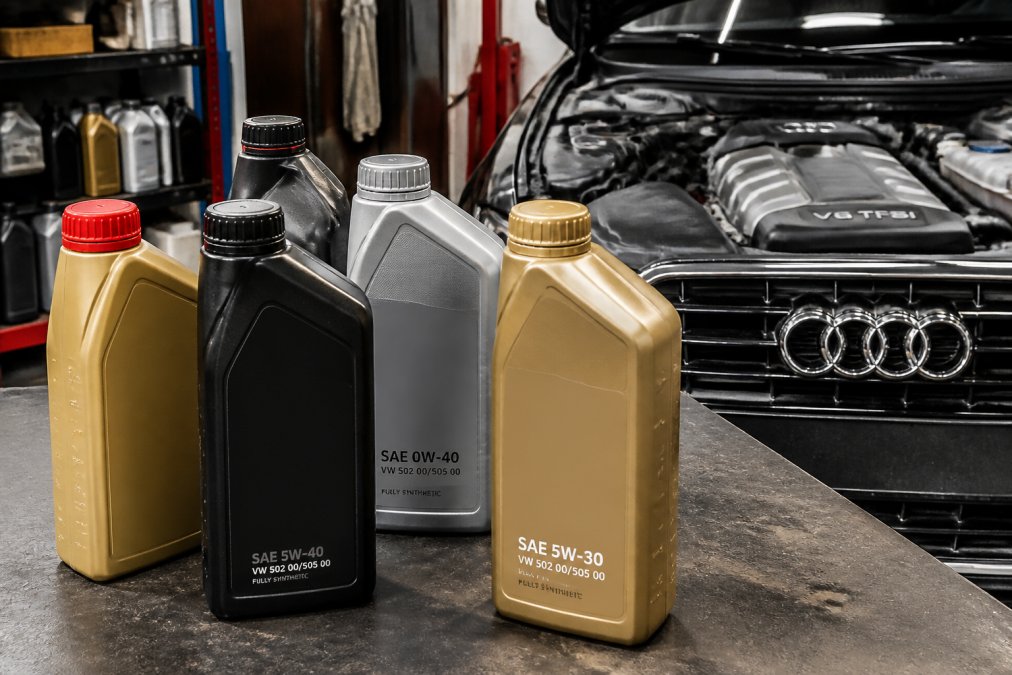
| Oil Brand | Viscosity Grade | VW Approval | Synthetic Type | Best For |
|---|---|---|---|---|
| Mobil 1 ESP | 5W-30 | 502.00/504.00 | Full Synthetic | Turbocharged engines, extended drain |
| Castrol Edge | 5W-30 | 502.00 | Full Synthetic | High mileage with seal conditioning |
| Shell Helix Ultra | 0W-30 | 502.00/504.00 | Full Synthetic | Cold climate, thermal stability |
| Valvoline SynPower | 5W-30 | 502.00 | Full Synthetic | Budget-conscious owners, reliable protection |
| Liqui Moly Molygen | 5W-30 | 502.00/504.00 | Full Synthetic | German engineering, sludge prevention |
What to Look for When Choosing High Mileage Oil
The right oil must meet three criteria: VW approval (502.00 or 504.00), full synthetic formulation, and strong seal conditioning.
Synthetic vs. Synthetic Blend for Older Audi Engines
For high mileage Audi engines, full synthetic is superior to synthetic blend in nearly every measurable way.
Frequently Asked Questions
What is the best engine oil brand for an Audi?
The best engine oil for your Audi depends on engine type and mileage. High mileage Audi engines benefit from oils meeting VW 502.00 or 504.00 specifications, which ensure proper viscosity, thermal stability, and seal conditioning. Full synthetic oils with enhanced detergent packages and friction modifiers protect turbocharged and direct injection engines better than conventional options. Always verify your specific model's manufacturer approval before purchasing.
Does high mileage oil actually help older engines?
Yes, high mileage oils are formulated specifically for engines over 75,000 miles. They contain seal conditioners that reduce oil consumption and gasket leaks, enhanced detergents to prevent sludge buildup, and improved oxidation resistance for better thermal stability. These additives address wear patterns common in older engines, helping maintain oil pressure and engine longevity when used consistently.
What oil do Audi dealers use?
Audi dealers typically use Audi-approved synthetic oils meeting VW 502.00 or 504.00 specifications. These approvals ensure the oil has the correct viscosity, additive package, and lubricity for Audi's turbocharged and direct injection engines. Using dealer-approved oils maintains warranty coverage and ensures compatibility with your vehicle's crankcase and piston ring tolerances.
How do I know if my high mileage Audi needs an oil change?
Monitor your oil level monthly and follow your owner's manual drain interval, typically 10,000 miles for synthetic oils in high mileage Audis. Watch for dark oil color, a burning smell, or increased oil consumption between changes. Oil analysis can reveal contaminant suspension levels and additive depletion, helping you determine if an early change is needed for turbocharged engines running hotter.