

7 Common Audi A4 Maintenance Issues to Watch
Table of Contents
- Excessive Oil Consumption and Sludge Buildup
- Timing Chain Tensioner and Camshaft Chain Wear
- Carbon Buildup in Intake Valves and Throttle Body
- Ignition Coil and Spark Plug Failures
- Water Pump and Coolant Leak Issues
- Understanding Your Audi A4 Maintenance Schedule
- How to Buy Audi OEM Parts Online and Avoid Costly Repairs
- Frequently Asked Questions
Last Updated: September 27, 2026
Excessive Oil Consumption and Sludge Buildup
Excessive oil consumption ranks among the most common Audi A4 maintenance issues to watch. Many owners report losing a quart or more every 1,000 miles due to worn piston rings and valve seals. Sludge buildup compounds the problem: when oil breaks down, it thickens and restricts flow, accelerating wear on the camshaft and crankshaft.
Early warning signs include:
- Dark smoke from the exhaust
- Burning oil smell inside and outside the vehicle
- Low oil level warnings appearing frequently
- Rough idle or hesitation during acceleration
Light consumption needs regular top-offs with quality synthetic oil. Severe cases require piston ring or valve seal replacement. Regular oil changes with correct viscosity slow this issue considerably.
Timing Chain Tensioner and Camshaft Chain Wear
The timing chain tensioner maintains proper tension on the timing chain. When it fails, the chain can skip or rattle, throwing off engine timing and causing serious damage, one of the most expensive Audi A4 maintenance issues because it requires deep engine access.
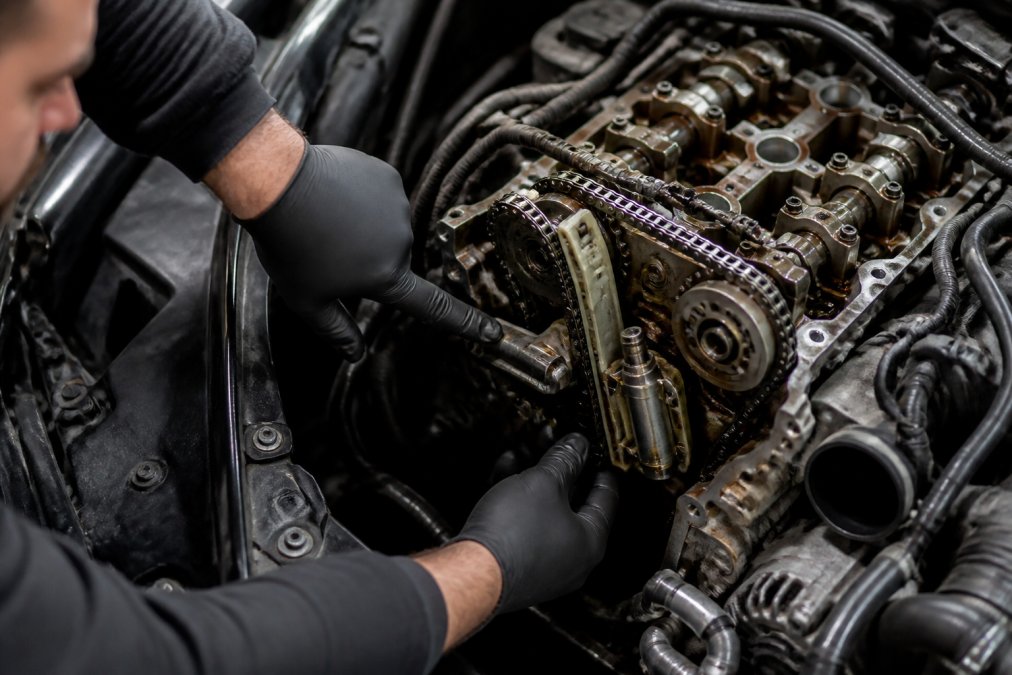
Symptoms include a rattling noise from the front of the engine during cold starts or hard acceleration, and timing-related check engine codes. Ignoring this leads to catastrophic engine damage.
Prevention strategies:
- Follow scheduled maintenance intervals strictly
- Use high-quality synthetic oil to reduce wear
- Listen for unusual noises and address them immediately
- Have a mechanic inspect the chain during routine service
Timing chain tensioners typically last 100,000 to 150,000 miles with proper care. Use genuine OEM components for replacement to ensure proper fit and longevity.
Carbon Buildup in Intake Valves and Throttle Body
Carbon deposits accumulate on intake valves and inside the throttle body over time, restricting airflow and reducing engine efficiency. This is a common issue affecting many Audi A4 models, particularly those with direct fuel injection systems. The fuel sprays directly into the combustion chamber rather than the intake valve, so the valves don't get cleaned by fuel spray like older engines.
Carbon buildup causes hesitation during acceleration, rough idle, poor fuel economy, and air-fuel ratio check engine lights.
Cleaning approaches vary by severity:
- Light buildup: use quality fuel system cleaners during regular fill-ups
- Moderate buildup: professional fuel system cleaning service
- Heavy buildup: intake valve cleaning or throttle body removal and cleaning
Prevention is simpler than treatment: use top-tier gasoline with better detergents, change your air filter regularly, and consider fuel system cleaner every 3,000 to 5,000 miles.
Ignition Coil and Spark Plug Failures
Ignition coils and spark plugs create the spark that ignites fuel. When either fails, you get misfires and rough running. B8 models (2009-2016) show coil degradation around 80,000-120,000 miles, while B9 models (2017-present) typically experience issues closer to 120,000-160,000 miles due to improved thermal management.
Early warning signs before complete failure:
Listen for ticking or pinging during cold starts, flickering check engine lights, rough idle, hesitation during acceleration, or unburned fuel smell. Catching these early prevents catalytic converter damage.
B8 models frequently experience coil failures on cylinders 1 and 4 due to heat exposure. B9 models show balanced failure distribution but are prone to issues if driven with faulty spark plugs. Turbo variants stress ignition components harder.
Spark plugs need replacement every 20,000 to 40,000 miles. Iridium plugs tolerate heat cycling better and reduce coil strain. Ignition coils typically fail between 80,000 and 150,000 miles.
A single ignition coil replacement costs $80-$150 (part) plus $100-$200 labor. Spark plugs cost $8-$25 each with $150-$300 labor for a full set. Replacing all four coils at once spreads labor costs and prevents future failures.
Maintenance tips:
2017-2025 Audi - Wiper Blade - Audi →
- Replace spark plugs at manufacturer-recommended intervals (consult your owner's manual for your specific model year)
- Use OEM or equivalent quality coils when replacement is needed; aftermarket coils have higher failure rates
- Address check engine lights promptly to prevent secondary damage to the catalytic converter
- Keep fuel injectors clean to reduce coil stress and improve combustion consistency
- If you hear ticking or pinging, have a mechanic scan for pending misfire codes before the check engine light illuminates
- Consider replacing coils proactively at 100,000 miles if your vehicle is still in regular use
Genuine OEM ignition coils ensure proper fit and reliable performance. Professional installation is worth the cost to ensure correct seating and electrical connections.
Water Pump and Coolant Leak Issues
The water pump circulates coolant through the engine to maintain proper operating temperature. When it fails, coolant leaks out and the engine overheats rapidly. This is a critical Audi A4 maintenance issue because overheating causes severe engine damage within minutes. Water pump failures are particularly common in the B8 generation (2009-2016), with many owners experiencing failure between 90,000 and 130,000 miles. B9 models (2017-present) show improved durability but still face pump wear by 120,000-150,000 miles, especially in vehicles driven in hot climates or with aggressive driving patterns.
Pre-failure warning signs to catch early:
Water pump problems rarely announce themselves with a sudden catastrophic failure. Instead, watch for these subtle indicators that precede a breakdown. A slight sweet smell under the hood (coolant odor) suggests a slow seep from the pump seal. You may notice a faint grinding or whining noise from the front of the engine, especially during cold starts or when the air conditioning compressor engages, this indicates bearing wear inside the pump. Some owners report the temperature gauge climbing slightly higher than normal during highway driving, even though the coolant level appears full. A white or green crusty deposit around the pump area (visible when you pop the hood) is dried coolant residue from a slow leak. If you catch these signs early, you can schedule a replacement before the pump fails completely and leaves you stranded.
Generation-specific failure patterns and timelines:
B8 A4 models use a serpentine belt-driven water pump that tends to develop seal wear around 100,000 miles. The bearing inside the pump gradually loosens, creating play that eventually ruptures the seal. B9 models use an electric water pump integrated with the cooling system, which eliminates belt-driven wear but introduces electronic failure modes. B9 electric pumps can fail suddenly if the control module malfunctions, though this is less common than mechanical seal failure in the B8.
Turbo variants in both generations run hotter coolant temperatures, accelerating pump wear.
Coolant leak sources and diagnostics:
Preventive replacement vs. reactive repair cost analysis:
Coolant system maintenance:
- Check coolant level monthly and top off with the correct type (G12+ or G13 for most A4 models; consult your owner's manual)
- Flush and refill coolant every 30,000 to 40,000 miles to prevent internal corrosion
- Inspect hoses and connections during routine service; replace any hose showing cracks or soft spots
- Replace the water pump proactively if your vehicle is approaching 100,000 miles, especially if you own a B8 or turbo variant
- Keep spare coolant and hoses in your vehicle for emergencies
- If you notice the temperature gauge climbing, pull over immediately and allow the engine to cool before adding coolant
Understanding Your Audi A4 Maintenance Schedule
Your Audi A4 maintenance schedule is your roadmap to preventing the issues above. Following it religiously keeps your vehicle running reliably and helps you catch problems before they become expensive. The schedule varies slightly by model year and engine type, so consult your owner's manual for specific intervals.
Standard maintenance intervals include:
- Oil and filter change: every 10,000 miles
- Air filter replacement: every 20,000 miles
- Cabin air filter: every 15,000 miles
- Spark plug replacement: every 20,000 to 40,000 miles
- Coolant flush: every 30,000 to 40,000 miles
- Transmission fluid service: every 40,000 to 80,000 miles
- Brake fluid replacement: every 24 months
How to Buy Audi OEM Parts Online and Avoid Costly Repairs
Buying genuine OEM parts online saves money compared to dealership prices while ensuring you get exactly what your vehicle needs. However, ordering the wrong part wastes time and money. Knowing how to verify compatibility prevents frustration.
Steps for successful online ordering:
- Verify your vehicle's year, model, and engine type
- Provide your VIN to the retailer for confirmation
- Check part compatibility before adding to cart
- Review return policies before purchasing
- Confirm shipping times match your timeline
Frequently Asked Questions
What is the most common problem with the Audi A4?
Excessive oil consumption and carbon buildup in the intake system are among the most frequent issues A4 owners encounter. These problems often stem from mechanical wear in the powertrain and fuel injector deposits that accumulate over time. Early warning signs include blue smoke from the exhaust, rough idle, and reduced fuel economy. Addressing these issues promptly with preventative maintenance and genuine OEM components helps avoid more costly repairs down the line.
How often should you perform maintenance on an Audi A4?
Audi A4 maintenance schedules typically call for oil and filter changes every 10,000 miles, with more comprehensive service intervals at 20,000, 40,000, and 60,000 miles. Scheduled service includes checking transmission fluid, coolant levels, and spark plugs according to your vehicle's generation and model year. Following the manufacturer's service intervals with genuine OEM parts prevents premature component failure and maintains long-term reliability. Consult your owner's manual or a qualified technician to confirm intervals specific to your A4.
Are Audi A4s expensive to maintain?
Maintenance costs depend on whether you use genuine OEM parts or aftermarket alternatives, and whether you perform routine service yourself. Routine maintenance like oil changes and filter replacements are moderately priced, but major repairs such as timing chain tensioner replacement or water pump service can range from $800 to $2,500. Using authentic OEM components from the start prevents catastrophic failures that cost far more. Proactive preventative maintenance with quality parts reduces total ownership expense over the vehicle's lifetime.
Can I replace Audi A4 parts myself, or do I need a professional?
Many routine maintenance tasks like wiper blade replacement, air filter changes, and spark plug installation are DIY-friendly for experienced owners. However, complex repairs involving the powertrain, timing chain, or transmission fluid service typically require professional tools and diagnostic equipment. When you source genuine OEM parts online from retailers like European OEM Parts, you have the flexibility to choose your mechanic or tackle simpler jobs yourself while maintaining factory specifications and warranty eligibility.
Audi A4 maintenance issues range from routine wear items to serious mechanical failures. Staying ahead of problems means following your maintenance schedule, using quality parts, and addressing warning signs immediately. When you need genuine OEM components, EUROPEAN OEM PARTS delivers authentic Audi, Porsche, and Volkswagen parts with fast nationwide shipping and industry-leading expertise. Get started with EUROPEAN OEM PARTS and keep your vehicle running at peak performance.