

Signs Your Audi Needs New Filters: 7 Warning Signs
Table of Contents
- 7 Signs Your Audi Needs New Filters
- How to Inspect Your Audi's Engine Air Filter
- Audi Engine Air Filter Replacement Interval: What the Service Manual Says
- Symptoms of a Bad Fuel Filter: Hesitation, Stalling, and Hard Starts
- Cabin Air Filter vs Engine Air Filter: Different Jobs, Different Symptoms
- Benefits of OEM Audi Filters Over Aftermarket Options
- DIY vs Professional Filter Replacement: What Audi Owners Should Know
- Frequently Asked Questions
Last Updated: September 11, 2026
7 Signs Your Audi Needs New Filters
Knowing the signs your Audi needs new filters can save you from expensive repairs and restore lost performance. This guide covers the warning signs, inspection steps, and replacement intervals that matter.
Filters protect three systems in your Audi: the engine air intake, the cabin ventilation, and the fuel delivery system. When any clog, you'll notice it in how the car drives, sounds, and smells.
Here are the seven warning signs that tell you it's time to replace your filters.
- Reduced acceleration and sluggish throttle response. A clogged engine air filter restricts airflow to the combustion chamber, and your Audi compensates by running rich.
- Visible dirt, gray discoloration, or blackened pleats on the filter element. If you can't see light through the pleats, the filter is done.
- Rough idling or engine misfire. Inconsistent airflow causes unstable combustion, especially at stoplights.
- Hesitation or stalling under load. A failing fuel filter starves the engine of fuel when you need power most.
- Hard starting, especially in cold weather. Low fuel pressure from a clogged fuel filter makes ignition unreliable.
- Weak airflow from your vents or lingering odors in the cabin. A dirty cabin air filter chokes your climate control system.
- A persistent service light or a drop in fuel efficiency. Modern Audi ECUs track air-fuel ratios and flag deviations.
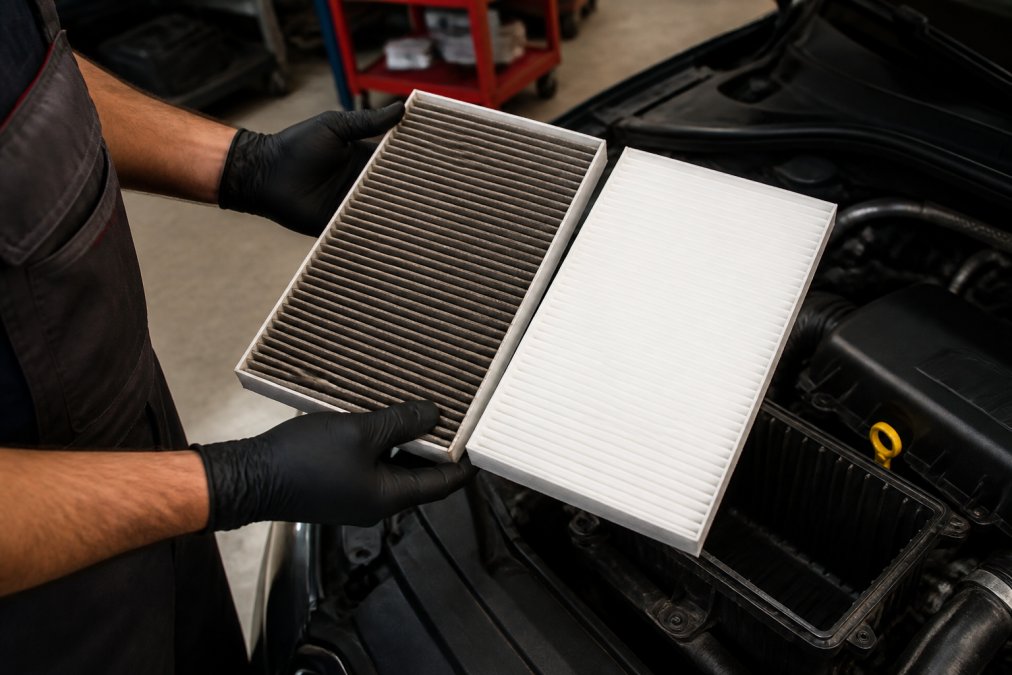
Most owners notice signs 3 through 5 first, but the visual signs are easiest to check yourself.
How to Inspect Your Audi's Engine Air Filter
Inspecting your engine air filter takes about ten minutes and only a screwdriver or socket set. Locate the plastic air box connected to the intake hose, unclip or unscrew the lid, and lift out the element.
Hold the filter up to a light source. A healthy filter lets light through the pleats; one that blocks light or has blackened, oily pleats needs replacement.
Visual Inspection: What Gray, Blackened, or Clogged Filters Look Like
Gray discoloration on the intake-facing pleats is normal dust accumulation. Blackened or oily pleats point to a deeper problem, often a crankcase ventilation issue pushing oil vapor into the intake, address that before installing a new filter.
If the filter is gray but still passes light, tap it gently to dislodge loose debris and reinstall it. If it fails the light test, replace it.
Audi Engine Air Filter Replacement Interval: What the Service Manual Says
Audi does not publish one universal air filter interval. The window shifts by chassis, engine, and driving conditions, so generic "every 30,000 miles" advice falls apart when you compare an A4 to a Q7.
Model-by-Model Engine Air Filter Intervals
| Model / Chassis | Typical Engine | Audi Service Interval | Notes |
|---|---|---|---|
| A3 / S3 (8V, 8Y) | 2.0T EA888 | 40,000 miles | Single rectangular panel filter in the air box |
| A4 / A5 / Q5 (B9, FY) | 2.0T EA888 | 40,000 miles | Air box sits behind the passenger-side headlight |
| A6 / A7 (C7, C8) | 2.0T / 3.0T | 40,000 miles | 3.0T uses a larger element; confirm by VIN |
| Q7 / Q8 (4M) | 3.0T | 40,000 miles | Dual intake path on some trims |
| TT / TTS (8S) | 2.0T EA888 | 40,000 miles | Tight engine bay; allow extra time |
| R8 (4S) | 5.2 V10 | 30,000 miles | Two filters, one per cylinder bank |
Audi's published interval is a maximum under ideal conditions, not a target. Most independent Audi specialists cut it roughly in half for real-world driving, about 20,000 miles on the EA888 family and 15,000 on the V10.
How Driving Conditions Shorten the Interval
| Driving Condition | Check Interval | Replace Interval |
|---|---|---|
| Highway, mild climate | Every 15,000 miles | 30,000-40,000 miles |
| City, stop-and-go | Every 10,000 miles | 20,000-30,000 miles |
| Dusty or unpaved roads | Every 5,000 miles | 15,000 miles |
| Cold climate, heavy idling | Every 10,000 miles | 20,000 miles |
| Wildfire smoke or heavy pollen season | Every 7,500 miles | 15,000-20,000 miles |
Cabin and Fuel Filter Intervals by Model
The engine air filter is only one of three filters on a service schedule. Cabin and fuel filters follow their own timelines:
- Cabin air filter: Audi specifies replacement roughly every 20,000 miles or two years on most A4, A5, Q5, A6, and Q7 models. Cars in high-pollen or high-particulate regions often need it annually.
- Fuel filter: On most modern Audi gasoline models the fuel filter is integrated into the in-tank fuel pump assembly and Audi treats it as a lifetime part under normal conditions. On TDI diesel models and older platforms with an external canister filter, replacement is typically specified around 60,000 miles.
Audi owner's manual and maintenance schedule lookup
Why the Interval Matters More on Turbocharged Engines
Every current Audi gasoline engine is turbocharged, and a turbo pulls far more air through the filter than a naturally aspirated engine of the same displacement. A restricted filter on a 2.0T or 3.0T raises the pressure drop across the element, forcing the turbo to spin harder to hit target boost, slower spool, higher intake air temperatures, and accelerated turbo bearing wear. On a V10 R8 with two filters, one clogged element can create a cylinder-bank imbalance the ECU must trim around.
That's why the interval is a ceiling, not a suggestion. In city traffic or dusty air, treat the shorter number in the table as your real replacement point.
Symptoms of a Bad Fuel Filter: Hesitation, Stalling, and Hard Starts
A clogged fuel filter produces symptoms that feel mechanical rather than electrical: hesitation when you press the throttle, stalling at low speeds, and hard starts after the car sits overnight. It traps rust, sediment, and debris before they reach the injectors; when it clogs, fuel pressure drops.
Watch for these specific signs:
- Engine misfire under acceleration, especially on hills
- Stalling shortly after startup or at idle
- A whining or buzzing sound from the fuel pump as it works harder
- Noticeably longer cranking time before the engine catches
- Surging or inconsistent power delivery
Fuel filter intervals vary by model and fuel quality. Many Audi models specify replacement around 60,000 miles, but poor fuel quality or a rusty tank can shorten that. With multiple symptoms at once, replace the filter before assuming a fuel pump failure.
Cabin Air Filter vs Engine Air Filter: Different Jobs, Different Symptoms
The engine air filter and cabin air filter serve different systems and fail in different ways. Confusing the two leads owners to replace the wrong part.
The engine air filter feeds the engine's combustion process. Its symptoms show up as performance loss: sluggish acceleration, misfires, and reduced fuel efficiency.
The cabin air filter cleans the air entering your climate control system. Its symptoms are comfort issues: weak vent airflow, musty odors, and extra dust inside the cabin. If your defroster struggles to clear the windshield, the cabin filter is the likely culprit.
Cabin filters typically need replacement every 15,000 to 25,000 miles, or annually in high-pollen or high-pollution areas (the EPA). They sit behind the glovebox or near the windshield cowl and take under fifteen minutes to swap.
Benefits of OEM Audi Filters Over Aftermarket Options
Aftermarket filters fall into three broad categories, and they are not interchangeable. Knowing the difference helps you decide whether an OEM filter is worth the premium.
The Three Filter Types You'll See on the Shelf
1. OEM paper/cellulose filters (what Audi installs at the factory). These use pleated cellulose or synthetic-blend media with a defined pleat count and a molded urethane or rubber gasket that seals against the air box. Filtration efficiency is typically in the high-90s percentage range for particles down to a few microns, held across the full service interval.
2. Standard aftermarket paper filters. Often visually similar to OEM, but pleat count, media density, and gasket durometer vary by brand. Fewer pleats means less surface area, so the filter loads up faster and restricts airflow sooner. A gasket that's too soft or too hard won't seat properly, letting unfiltered air bypass the element.
3. High-flow oiled cotton or dry synthetic filters. Marketed on airflow gains, and they do flow more air when clean. The trade-off is filtration efficiency: oiled cotton passes more fine particulate than a good paper element, and the oil film can migrate downstream and contaminate the mass airflow sensor on a turbocharged Audi. On a direct-injection EA888 or 3.0T, a fouled MAF sensor produces lean/rich codes, rough idle, and reduced fuel economy, the symptoms you were trying to avoid.
OEM vs Aftermarket: A Direct Comparison
| Attribute | OEM Audi Filter | Standard Aftermarket | High-Flow Oiled/Synthetic |
|---|---|---|---|
| Filtration efficiency | High, tested to Audi spec | Varies by brand | Lower for fine particulate |
| Fitment tolerance | Molded to chassis-specific air box | Usually close, sometimes loose | Varies; some require adapter kits |
| Airflow when clean | Baseline | Baseline | Higher |
| Airflow when loaded | Gradual decline | Can decline faster | Declines sharply once oiled media loads |
| MAF sensor risk | None | Low | Elevated on oiled media |
| Warranty impact | None | None | Can complicate emissions-related claims |
| Typical price | Higher | Lower | Mid to high |
What Actually Matters on a Turbocharged Audi
Three factors decide whether an aftermarket filter is safe:
- Seal integrity. The filter only works if air can't get around it. A gasket that doesn't compress evenly against the air box lets dust bypass the element and reach the compressor wheel and cylinder walls on a turbo engine, the most common failure mode of cheap aftermarket filters.
- Media efficiency at the micron level. Engine wear is driven by particles in the 5-20 micron range. A filter that flows well but passes them trades long-term engine life for a marginal horsepower gain.
- MAF compatibility. Audi's mass airflow sensors are calibrated to a specific intake tract. Oiled filters that shed oil onto the sensor element skew that calibration; dry synthetic filters avoid this but still vary in efficiency.
When Aftermarket Makes Sense
Aftermarket is not automatically worse. A reputable dry synthetic panel filter from a brand that publishes filtration efficiency and fitment data can be a reasonable OEM alternative, especially in dusty conditions. Verify three things before buying: the filter is listed for your exact chassis and engine code, the gasket is molded (not glued-on foam), and the manufacturer publishes a filtration efficiency number rather than only an airflow claim.
If you want the filter your Audi was designed around, sourcing genuine OEM parts ensures the fitment and filtration match factory standards. EUROPEAN OEM PARTS stocks OEM filters for Audi, Porsche, and Volkswagen models and ships nationwide.
DIY vs Professional Filter Replacement: What Audi Owners Should Know
Replacing an engine or cabin air filter is one of the most accessible DIY jobs on an Audi. Both need basic hand tools, no diagnostic equipment, and take under thirty minutes combined.
Do it yourself if: you're comfortable with a screwdriver and socket set, your filter housing uses clips or standard fasteners, and you can access the filter without removing major components.
Take it to a shop if: your model requires removing the intake manifold or other major components, you're dealing with a fuel filter on a high-pressure system, or you're not comfortable working around fuel lines.
Fuel filter replacement is the one job where most owners should defer to a professional. Modern Audi fuel systems run at high pressure, and improper handling can create a safety hazard.
For engine and cabin filters, DIY is straightforward and saves labor. Order the correct OEM part for your model year and trim, and installation is essentially plug-and-play.
Filters are the cheapest insurance policy your Audi has, yet they're the most commonly neglected maintenance item. When you notice sluggish acceleration, rough idling, or weak cabin airflow, don't wait for a check engine light. EUROPEAN OEM PARTS stocks genuine OEM filters for Audi, Porsche, and Volkswagen, backed by industry expertise and fast nationwide shipping, so you get the exact part your vehicle was engineered for. Browse our catalog, confirm fitment for your model, and get your Audi breathing clean again.
Frequently Asked Questions
How often should I replace my Audi engine air filter?
Most Audi models call for an engine air filter replacement every 15,000 to 30,000 miles, but dusty or high-traffic driving can shorten that window. Check your service manual for the exact interval for your model year and engine. Inspect the filter at every oil change: if it looks gray or blackened, replace it early. Sticking to the recommended Audi engine air filter replacement interval protects airflow and fuel efficiency.
Can a dirty air filter cause my Audi to misfire?
Yes. A clogged engine air filter restricts airflow to the engine, which throws off the air-fuel ratio and can trigger an engine misfire, rough idle, or hesitation under acceleration. You may also see a check engine light. If misfiring continues after replacing the filter, have the ignition system checked, since spark plugs and coils can produce similar symptoms on Audi engines.
Will I notice a difference with a new air filter?
Many drivers notice sharper throttle response and smoother acceleration after replacing a badly clogged filter. If the old filter was heavily restricted, fuel efficiency may improve as well. The change is most obvious on turbocharged Audi engines, which are sensitive to intake airflow. A new cabin filter also restores ventilation and climate control performance if airflow from the vents felt weak.
What are the symptoms of a bad fuel filter?
Symptoms of a bad fuel filter include hesitation during acceleration, stalling at idle, hard starting, and a noticeable drop in engine performance. A clogged filter strains the fuel pump and can eventually cause lean-running conditions. Most Audi models recommend fuel filter replacement around 30,000 to 60,000 miles, though some use a lifetime in-tank design. Check your service manual before ordering a replacement.