

How to Inspect European Car Brakes at Home
Table of Contents
- What You'll Need Before Starting Your Brake Inspection
- How to Inspect European Car Brakes: Check Your Brake Fluid Reservoir
- Minimum Brake Pad Thickness for Audi, Porsche, and Volkswagen
- Visual Inspection of Brake Rotors and Calipers
- How to Use an OBD2 Scanner for Brake Service Mode
- Genuine vs Aftermarket Brake Parts: Why OEM Matters
- Warning Signs of Brake Failure and When to Seek Professional Repair
- Common Mistakes to Avoid During DIY Brake Inspection
- Frequently Asked Questions
Last Updated: September 19, 2026
What You'll Need Before Starting Your Brake Inspection
Before you inspect European car brakes at home, gather the right tools. You'll need a few items to do the job safely and correctly.
Here's what to have ready:
- Jack and jack stands (rated for your vehicle's weight)
- Lug wrench (European vehicles often use different bolt sizes than domestic cars)
- Flashlight or work light
- Tire pressure gauge
- Brake fluid test strips (to check moisture content)
- Measuring ruler or caliper (to measure pad thickness)
- OBD2 scanner (for reading brake sensor codes)
- Clean rags and brake cleaner
- Safety glasses and gloves
- Vehicle service manual (for your specific Audi, Porsche, or Volkswagen model)
Having these tools on hand before you start prevents frustration. You won't have to stop midway to find something you forgot. European vehicles have specific requirements, so verify your lug bolt size before beginning. Most Audi, Porsche, and Volkswagen models use metric bolts, which differ from standard American hardware.
How to Inspect European Car Brakes: Check Your Brake Fluid Reservoir
The brake fluid reservoir is your first checkpoint. It tells you whether your system has enough fluid and whether moisture has contaminated it.
Locate the brake fluid reservoir under your hood. On most Audi, Porsche, and Volkswagen models, it sits near the back of the engine bay. The reservoir is usually a translucent plastic container with a removable cap.
Reading the MIN and MAX marks
Every brake fluid reservoir has two marks: MIN and MAX. Your fluid level should sit between these lines.
If the level drops below MIN, your brake pads may be worn. Brake fluid level naturally drops as pads wear down, this is normal. However, a sudden drop suggests a leak in the hydraulic system. Check the area under your vehicle for fluid spots.
If the fluid sits above MAX, do not drive the vehicle. Overfilled reservoirs can cause brake fluid to leak onto hot engine components and create a fire hazard.
Identifying amber fluid and moisture concerns
Brake fluid should be clear or slightly yellow. Over time, it absorbs moisture from the air. When moisture builds up, the fluid turns amber or dark brown.
Contaminated brake fluid lowers the boiling point of your hydraulic system. This causes brake fade, a loss of stopping power when brakes get hot. On the track or during heavy braking, fade becomes dangerous.
Use brake fluid test strips to check moisture content. Dip a strip into the reservoir. If the strip shows moisture levels above 3%, your fluid needs replacement. Genuine brake fluid for Audi, Porsche, and Volkswagen vehicles ensures your system meets factory specifications.
Minimum Brake Pad Thickness for Audi, Porsche, and Volkswagen
Brake pad thickness determines how much braking power you have left. European vehicles require specific minimum thicknesses set by the manufacturer.
For most Audi and Volkswagen models, the minimum pad thickness is typically around 4 millimeters. Porsche models often specify 5 millimeters. Once pads reach these limits, they must be replaced immediately. Driving on pads thinner than this risks damage to your brake rotors.
Measuring pad thickness without removing wheels
You can measure pad thickness without taking off your wheels. Use a flashlight to look through the wheel spokes at the brake caliper. You'll see the metal backing plate and the friction material on top of it.
Place a ruler against the wheel spoke and estimate the thickness of the friction material. If it looks thinner than a quarter-inch (about 6 millimeters), your pads are nearing the end of their life. Measure both the inner and outer pads, they wear at different rates depending on your driving style.
For a more precise measurement, remove the wheel. Once the wheel is off, you can use a caliper to measure the exact thickness. This takes a few extra minutes but gives you a clear reading.
Understanding wear sensor signals
European vehicles come equipped with wear sensors. These small electronic devices sit inside the brake pad material. When pads wear down, the sensor touches the rotor and completes an electrical circuit.
When the circuit closes, your ABS warning light illuminates on the dashboard. This amber light tells you pads have reached their minimum thickness. Do not ignore this signal. The sensor exists to prevent you from driving on metal-to-metal contact.
Some drivers disable warning lights or ignore them. This causes rotor damage, which costs significantly more to repair than replacing pads early. Genuine wear sensors ensure your vehicle's electrical system functions as designed.
Visual Inspection of Brake Rotors and Calipers
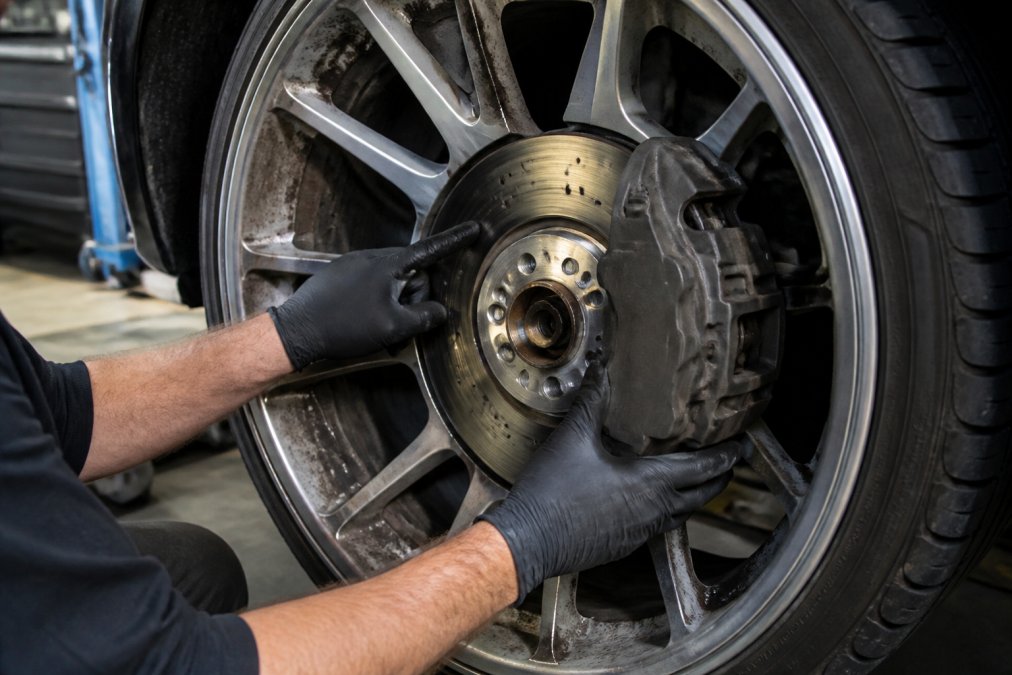
Your rotors and calipers do the actual work of stopping your vehicle. A visual inspection reveals whether they're healthy or failing.
Start by looking at the rotor surface. A healthy rotor has a smooth, even surface with a slight sheen. The metal should look uniform across the entire braking surface.
Spotting rotor grooves and scoring
Rotor grooves are deep scratches running across the braking surface. Light grooves are normal, they form from friction between pads and rotor. Heavy grooves mean your pads have worn through to the metal backing.
Scoring is different. Scoring looks like deep gouges or cracks radiating from the center of the rotor. Scoring happens when metal pads contact the rotor directly.
Brake dust and wheel cleaning during inspection
Brake dust accumulates on your wheels during normal driving. This black, powdery dust comes from friction between pads and rotors. Heavy brake dust buildup signals aggressive braking or worn pads.
How to Use an OBD2 Scanner for Brake Service Mode
An OBD2 scanner reads fault codes from your vehicle's onboard computer. European vehicles store brake system errors that you can't see with your eyes.
Accessing the ABS warning light diagnostics
When your ABS warning light comes on, a fault code has triggered. The scanner displays this code as a letter-number combination, like P0500 or C1234.
Reading brake sensor fault codes
Brake sensor codes tell you which sensor has failed. A code like C1145 means the right front wheel speed sensor is faulty. Codes starting with C indicate chassis or brake system problems.
Genuine vs Aftermarket Brake Parts: Why OEM Matters
Your brake system is not the place to cut costs. Genuine OEM parts are engineered specifically for your vehicle's weight, suspension, and braking power.
Verifying authentic Audi, Porsche, and Volkswagen components
Counterfeit brake parts exist. Fake pads and rotors look similar to genuine ones but fail prematurely.
Warning Signs of Brake Failure and When to Seek Professional Repair
Some brake problems require professional attention immediately. Knowing these warning signs prevents accidents.
Your brakes are failing if you notice these symptoms:
- Brake pedal goes to the floor without stopping the vehicle
- Brake pedal feels spongy or soft, even after pumping it
- Grinding metal sound when braking
- Vehicle pulls sharply to one side when braking
- Brake fluid leaking under your vehicle
- ABS warning light stays on after you clear the code
Spongy pedal feel and brake fade indicators
A spongy pedal means air is in your hydraulic lines. Air compresses, making your pedal feel soft. This reduces braking power dramatically.
Grinding and squealing noises explained
Squealing usually means your pads are worn. Wear sensors create this high-pitched sound to alert you. Replace pads immediately.
Common Mistakes to Avoid During DIY Brake Inspection
Most DIY brake problems come from skipping steps or using wrong parts.
Frequently Asked Questions
What is the minimum brake pad thickness for safety on an Audi or Porsche?
Most Audi and Porsche vehicles require a minimum brake pad thickness of 3-4 millimeters for safe operation. Check your owner's manual for your specific model's threshold. Many European vehicles include wear sensors that alert you when pads reach minimum thickness. Pads thinner than the manufacturer's specification reduce stopping distance and increase brake fade during aggressive driving or track use.
How do I use an OBD2 scanner to check brake system fault codes?
Connect your OBD2 scanner to the diagnostic port under the steering wheel. Power on the vehicle and select 'Read Codes' on the scanner. Look for brake-related codes (typically starting with 'C' for chassis systems). European vehicles often store ABS and brake sensor codes that require professional interpretation, but a scanner helps identify whether a warning light indicates a real fault or a sensor reset issue.
How often should I inspect the brakes on my European vehicle?
Inspect your brakes every 6 months or before long trips. Check brake fluid levels monthly. If you notice squealing, grinding, or a spongy pedal, inspect immediately. European engineering typically delivers longer pad life than domestic vehicles, but track day use or aggressive driving shortens inspection intervals significantly. Your maintenance schedule in the owner's manual provides model-specific guidance.
Why should I use genuine OEM brake parts instead of aftermarket alternatives?
Genuine OEM brake parts are engineered to exact specifications for your Audi, Porsche, or Volkswagen's hydraulic system, ABS integration, and sensor compatibility. Aftermarket parts may not fit brake calipers correctly or may trigger ABS warning lights due to sensor misalignment. OEM components ensure consistent brake fade resistance, stopping distance, and long-term reliability. For vehicles you plan to keep long-term or use on track, OEM parts preserve resale value and safety margins.
Brake inspections take time, but they reveal problems before they become dangerous. Your vehicle's stopping power depends on catching wear early. Use this guide to inspect your brakes thoroughly, then order genuine OEM parts from European OEM Parts to keep your European vehicle performing safely and reliably.