

Porsche 911 Spark Plug Replacement Cost Estimate
Table of Contents
- Porsche 911 Spark Plug Replacement Cost Estimate: What Drives the Price
- Average Cost Breakdown: Labor vs. Parts
- Porsche 911 Maintenance Schedule: When Spark Plugs Are Due
- Genuine Porsche Spark Plugs vs Aftermarket: What Fits Your Engine
- DIY Porsche 911 Spark Plug Replacement: Can You Do It Yourself?
- Symptoms of Failing Spark Plugs and Engine Performance Impact
- The 'While You Are In There' Factor and Visual Inspection Guide
- Conclusion: Getting an Accurate Spark Plug Replacement Quote
- Frequently Asked Questions
Last Updated: October 2, 2026
Porsche 911 Spark Plug Replacement Cost Estimate: What Drives the Price
A Porsche 911 spark plug replacement cost estimate depends less on the plugs than on how much of the car must come apart to reach them. Plugs are inexpensive, often under twenty dollars each; labor moves the number, and on a rear-engine 911 it climbs quickly.
Below: what drives the price, when service is due, and how to choose a shop.
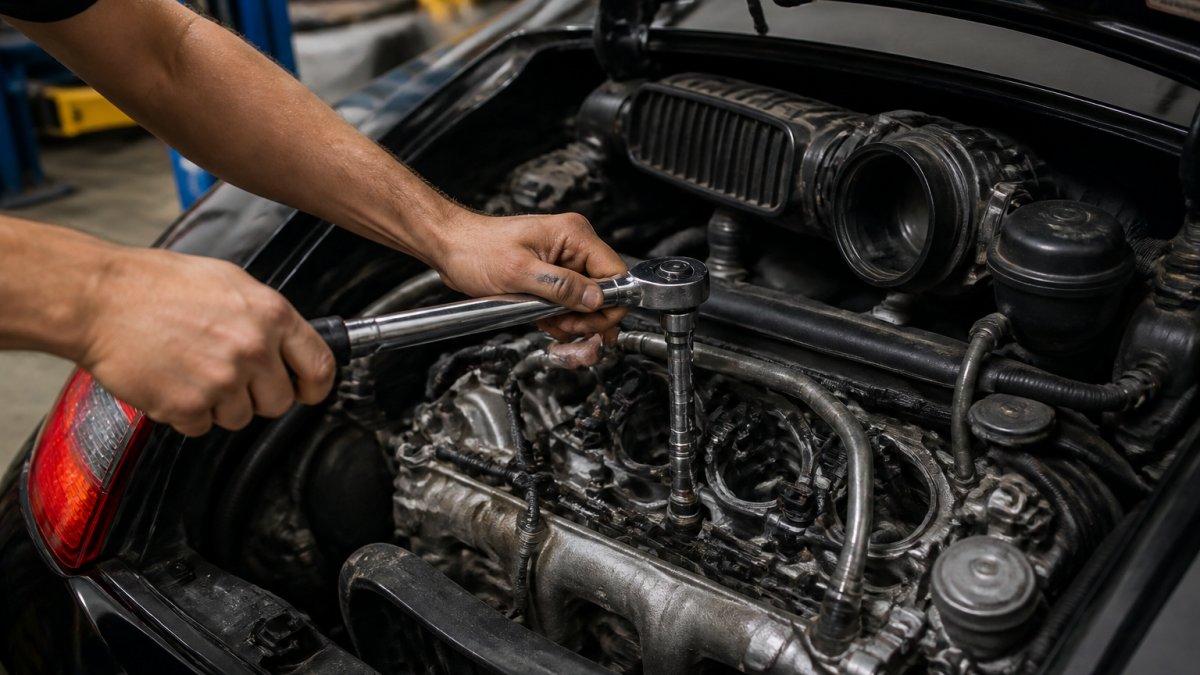
Why the Rear-Engine Layout Changes Everything
The 911's flat-six sits behind the rear axle, tucked under a low decklid and packed against exhaust and cooling hardware. On a front-engine car, a plug change is a straightforward top-end job; on a 911, technicians often remove the rear wheels, inner fender liners, and portions of the exhaust or heat shielding to reach the cylinder head.
That access work explains why a job under an hour on a typical sedan can take several hours on a 911, and why labor, not parts, dominates the invoice.
Average Cost Breakdown: Labor vs. Parts
Parts are the smaller half of the bill: six iridium or platinum-tipped plugs for a flat-six run a modest amount, while labor is billed hourly against a published service time. The final figure depends on your local labor rate, your 911's generation, and whether the shop follows Porsche's book time.
Because rates vary by region and shop, treat any single number with caution. Ask for labor hours and the hourly rate separately, then add parts cost.
What Independent Shops Charge vs. Dealership Service Centers
Independent Porsche specialists usually charge a lower hourly rate than a franchised dealership, and many have deeper experience with air-cooled and early water-cooled cars.
| Factor | Independent Specialist | Dealership Service Center |
|---|---|---|
| Hourly labor rate | Lower | Higher |
| Parts markup | Often lower | Typically higher |
| Model-year familiarity | Varies by shop | Broad across generations |
| Warranty handling | Case by case | Factory-aligned |
For an older 911 where parts are harder to source, an independent specialist who knows the car can save time and money. For a car under a powertrain warranty, a dealership keeps the service record clean.
Porsche 911 Maintenance Schedule: When Spark Plugs Are Due
Porsche does not publish one universal spark plug interval for the 911; the schedule is set per generation and engine, and the gap between a 997 and a 992 is large enough that a single number would mislead you.
| Generation | Typical engine | Common plug interval | Notes |
|---|---|---|---|
| 996 / 997 (early water-cooled) | 3.4L-3.8L flat-six | Roughly 30,000-40,000 miles | Coil-on-plug; rear access tight, exhaust hardware often seized |
| 997.2 / 991.1 | 3.6L-3.8L DFI flat-six | Roughly 40,000 miles or 4 years | Direct injection; carbon fouling more common on short-trip cars |
| 991.2 | 3.0L-3.8L twin-turbo flat-six | Roughly 30,000-40,000 miles | Turbo heat accelerates electrode wear; many shops recommend the shorter end |
| 992 | 3.0L-3.8L twin-turbo flat-six | Roughly 30,000-40,000 miles | Same turbo heat penalty; access requires more disassembly than 991 |
| Turbo / Turbo S / GT models | 3.8L-4.0L | Often 30,000 miles or less | Track use and high boost shorten effective life |
Treat these as working ranges, not gospel. Porsche has revised intervals across model years, and a dealer can pull the correct schedule for your VIN in minutes.
Why the Interval Is Shorter Than You Expect
Two forces push 911 plug intervals down relative to a typical naturally aspirated sedan. First, most modern 911 engines are turbocharged or direct-injected, and both raise cylinder pressure and heat, wearing the electrode and eroding the gap faster. Second, the flat-six sits low and tight in the rear, so plugs see more heat soak from surrounding exhaust and cooling hardware than a front-engine layout would.
Time Matters as Much as Mileage
A 911 that sits for months between drives can still need fresh plugs on schedule: fouling and gap corrosion happen with age and repeated cold starts, not just distance. A common pattern is a low-mileage garage-kept car that hits the four-year mark with only 18,000 miles and still runs rough on cold start because the plugs have aged out.
The Generation Gap That Changes the Labor, Not Just the Interval
The interval is only half the story: cost depends heavily on which generation you own, because engine accessibility changed dramatically across the water-cooled era.
That is why two owners with the same nominal interval can get quotes hundreds of dollars apart. The schedule tells you when; the generation tells you how much labor the when will cost.
Genuine Porsche Spark Plugs vs Aftermarket: What Fits Your Engine
Genuine Porsche spark plugs are the factory-specified components for your engine, matched to its heat range and ignition system. Aftermarket plugs can work well, but only if heat range, thread, and electrode type match the factory spec exactly; a mismatch shows up as rough idling, misfires, or a check engine light.
For owners who want factory standards and long-term reliability, Porsche's official owner resources and technical documentation are the reference point for the correct part number. This is where buying genuine components pays off: you get the exact plug the engine was tuned around.
Iridium and Platinum-Tipped Options Explained
Iridium and platinum-tipped plugs use a harder electrode material that resists wear, so they last longer than basic copper plugs and hold a stable gap. Most modern 911 engines specify a precious-metal plug for exactly this reason; installing a cheaper plug to save a few dollars can cost far more in misfires and repeat labor.
DIY Porsche 911 Spark Plug Replacement: Can You Do It Yourself?
A DIY Porsche 911 spark plug replacement is possible for a confident home mechanic, but whether it is wise depends almost entirely on which generation you own. The rear-engine layout is the constant; the amount of stuff in the way is not.
Generation-by-Generation DIY Feasibility
996 and 997 (early water-cooled): The most DIY-friendly of the modern 911s.
997.2 and 991.1: Tighter packaging.
991.2 and 992: The least DIY-friendly of the group. The twin-turbo packaging and rear structure add disassembly steps that reward a lift and factory service information.
Turbo, Turbo S, and GT models: Treat these as specialist-only unless you have significant 911 experience.
Tools You Actually Need
- A quality torque wrench that reads in the low range the factory spec calls for
- The correct thin-wall spark plug socket for your plug size
- A full extension and swivel set, because straight-on access is rare on a 911
- A trim removal set for fender liners and plastic fasteners
- Factory service information for your generation, not a generic guide
The Mistakes That Turn a Cheap Job Into an Expensive One
Over-tightening is the classic error. Aluminum cylinder heads strip easily, and a stripped plug thread means a head repair, not a plug swap.
Cross-threading is the second. Start every plug by hand until it seats, then bring the wrench in; a cross-threaded plug in a 911 head is a very bad day.
Dropping a plug or socket into the engine bay is the third.
When to Hand It Off
If you own a 991.2 or 992, lack a lift, or have never worked on a rear-engine car, the labor you pay a specialist is often cheaper than the parts and downtime from a mistake. For 996 and 997 owners with basic tools and patience, DIY is a realistic weekend project that saves the labor line entirely.
The 'While You Are In There' Factor
Because reaching the plugs requires so much disassembly, a smart owner uses the job as an opportunity. If the coils, heat shields, or related ignition hardware show wear, replacing them during the same service avoids paying for the same labor twice. On a 991 or 992, where disassembly is deepest, bundling related work is the single biggest way to control cost.
Visual Inspection Guide: Reading Your Old Plugs
Before you reassemble, look at what came out. The color and condition of each plug tells you something about that cylinder.
- Light tan or gray: Normal. The engine is running as designed.
- Black, sooty, dry: Rich mixture or too-cold a heat range. Common on short-trip cars.
- Black and oily: Oil entering the cylinder, often valve guides or rings. A deeper diagnosis is needed.
- White or blistered: Lean condition or overheating. Do not ignore this.
- Worn, rounded electrode or wide gap: Normal wear for the mileage, but confirms the interval was due.
- One plug different from its five neighbors: That cylinder has an issue. Investigate before you button it up.
A consistent reading across all six cylinders is healthy; a single outlier is the engine telling you where to look next.
Symptoms of Failing Spark Plugs and Engine Performance Impact
Worn plugs announce themselves through how the engine behaves: rough idling, hesitation or acceleration lag under load, a drop in fuel efficiency, and a check engine light tied to a misfire code.
The performance impact is real: a misfiring cylinder wastes fuel and stresses the ignition system. On a 911, degraded plugs also dull throttle response, which is the opposite of why you bought the car.
The 'While You Are In There' Factor and Visual Inspection Guide
Because reaching the plugs requires so much disassembly, a smart owner uses the job as an opportunity. If the coils, heat shields, or related ignition hardware show wear, replacing them during the same service avoids paying for the same labor twice.
For owners sourcing parts ahead of the job, the National Highway Traffic Safety Administration's vehicle safety resources are useful for checking recalls, and the U.S. Department of Energy's fuel economy guidance helps explain how ignition health affects efficiency.
Conclusion: Getting an Accurate Spark Plug Replacement Quote
The challenge with any 911 spark plug estimate is that the headline number hides the real variable: labor driven by the rear-engine layout.
That is where EUROPEAN OEM PARTS makes the parts side simple. We stock genuine Porsche ignition components, offer exclusive pricing on authentic OEM parts, and ship nationwide so your project is not stalled waiting on a box.
Frequently Asked Questions
How much is a spark plug change at a Porsche dealer?
Dealership pricing for a Porsche 911 spark plug replacement varies by generation and location. The total reflects a higher labor rate, OEM parts markup, and shop supplies. On rear-engine 911 models, the labor alone can dominate the bill because accessing the cylinder head requires removing engine bay components. Request a written service quote from your dealer and compare it against an independent Porsche specialist to see the real difference.
How long do Porsche 911 spark plugs last?
Most Porsche 911 models use iridium or platinum-tipped spark plugs designed to last 30,000 to 40,000 miles under normal driving. If you track the car, do frequent cold starts, or deal with rough idling, plan to replace them sooner. Following the Porsche 911 maintenance schedule in your service manual keeps the ignition system healthy and protects fuel efficiency and throttle response.
Does the engine model affect spark plug replacement costs?
Yes. The 996, 997, 991, and 992 generations have different engine bay accessibility and torque specifications. Earlier air-cooled models and turbocharged flat-six engines often require more disassembly to reach the cylinder head, which raises labor time. A 991 or 992 may take fewer hours than a 996 Turbo, so always give your shop the exact model year and engine code when requesting a service quote.
Can I use aftermarket spark plugs instead of genuine Porsche parts?
You can, but the risk is gap adjustment and heat range mismatches that cause engine misfire or acceleration lag. Genuine Porsche spark plugs are pre-gapped and matched to your engine's ignition system. If you choose aftermarket, verify the part number against your service manual and check the gap before installation. OEM components remain the safest choice for preserving powertrain warranty coverage.