

DIY Maintenance Tips for Volkswagen Owners
Table of Contents
- Why DIY Maintenance Pays Off for Volkswagen Owners
- Best Tools for Volkswagen Repair: The Essentials
- Your Volkswagen Maintenance Schedule Explained
- DIY Brake Pad Replacement VW: Step-by-Step
- Genuine Volkswagen Parts for Sale: Why OEM Matters
- Warranty Preservation and Common DIY Mistakes to Avoid
- Frequently Asked Questions
Last Updated: September 16, 2026
Why DIY Maintenance Pays Off for Volkswagen Owners
DIY maintenance tips for Volkswagen owners start with one hard truth: the dealership service bay is the most expensive place your car will ever visit. Doing your own oil changes, brake work, and fluid checks keeps money in your pocket and gives you control over the parts going into your vehicle. At EUROPEAN OEM PARTS, we supply genuine Audi, Porsche, and Volkswagen components.
Best Tools for Volkswagen Repair: The Essentials
The best tools for Volkswagen repair match German engineering tolerances: a quality socket set, a torque wrench, jack stands, and a diagnostic scanner. Buy these once and they serve every job on this list.
Diagnostic and Safety Gear
An OBD-II scanner is the most underrated tool in a DIY garage. It reads and clears fault codes and monitors live data like coolant temperature and fuel trims. Basic code readers handle engine faults; a scanner with Volkswagen-specific software reaches modules a generic reader cannot see.
| Tool | Purpose | Priority |
|---|---|---|
| Metric socket set | Fasteners, brackets, covers | Essential |
| Torque wrench | Brake calipers, wheels, suspension | Essential |
| Jack and jack stands | Lifting and supporting the car | Essential |
| OBD-II scanner | Fault codes, service resets | Essential |
| Oil filter wrench | Filter removal | Job-specific |
| Fluid extractor | Oil, coolant top-offs | Convenient |
Your Volkswagen Maintenance Schedule Explained
A Volkswagen maintenance schedule is a mileage-based plan telling you what to inspect or replace, and when. Intervals are model- and engine-specific: a 2015 Golf TDI, a 2019 Jetta 1.4T, and a 2022 Tiguan 2.0T do not share the same service plan, even though they share a brand.
- Every oil change: oil filter, drain plug washer, fluid level check, tire pressure check
- Every 20,000-30,000 miles: engine air filter, cabin air filter (sooner in dusty or high-pollen regions)
- Every 30,000-40,000 miles: spark plugs on many turbocharged engines; check your specific engine code
- Every 40,000 miles: DSG transmission fluid service on models equipped with a dual-clutch gearbox
- Every 2 years: brake fluid flush regardless of mileage
- Every 60,000-80,000 miles: timing belt on belt-driven engines (chain engines follow a different inspection path)
- Annually: battery health, tire rotation, chassis lubrication points, and a full fault-code scan
Reading Your Service Manual Like a Technician
The owner's manual gives you the interval; the factory service manual gives you the procedure, torque specs, and fluid capacities. Most owners never open it, which is why they miss steps like the drain plug washer replacement or the correct fill quantity for a DSG service. If you plan to do your own work long-term, the service manual is the best investment after a torque wrench.
Seasonal Preparation Checklist
Seasonal preparation turns a maintenance schedule into a survival plan. Cold starts in winter and heat soak in summer stress different systems, and a pre-season inspection catches the failures that strand drivers.
- Test battery and clean terminal corrosion, cold cranking amps drop in low temperatures, and a marginal battery that starts fine in July can fail in January
- Check coolant strength before winter with a hydrometer or refractometer; a weak mix can freeze and crack a block or heater core
- Top off windshield washer fluid with a cold-weather mix rated for sub-freezing temperatures
- Inspect tire tread depth and set pressures for temperature swings, tire pressure drops roughly 1 PSI for every 10°F drop in ambient temperature
- Scan for stored fault codes before a long trip so a pending issue does not become a roadside breakdown
- Inspect wiper blades and replace before the rainy season; streaking blades are a safety issue, not a cosmetic one
- Check the cabin air filter before pollen season and the engine air filter before a dusty road trip
Resetting Service Indicators After DIY Work
After a scheduled service, the instrument cluster may still display a service reminder. Resetting service indicators varies by model and generation: some Volkswagen models reset through the infotainment menu, while others require a scan tool to clear the reminder in the instrument cluster module. Skip this step and the reminder keeps appearing, costing you accurate interval tracking. A scan tool with Volkswagen-specific service functions pays for itself the first time you reset an oil service reminder without a dealership visit.
DIY Brake Pad Replacement VW: Step-by-Step
DIY brake pad replacement VW owners can complete in a home garage with hand tools and about two hours per axle. The job is mechanical, not mysterious, but it demands attention to torque specs, part quality, and, on newer models, electronic parking brake procedures that can turn a simple job into an expensive one if skipped.
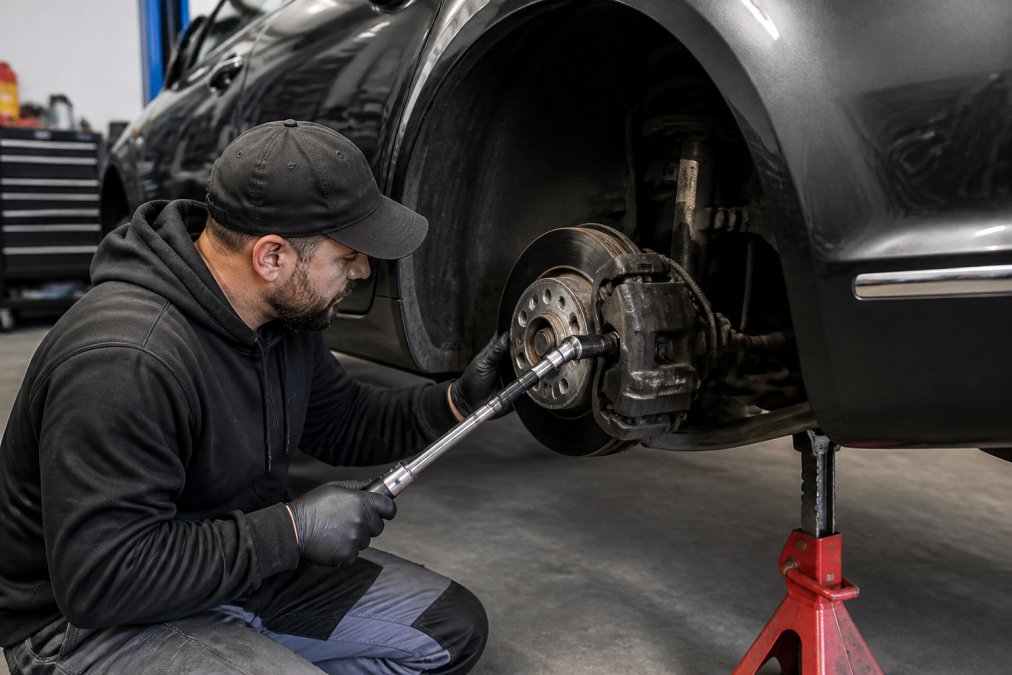
- Loosen lug bolts, lift the car, and secure it on jack stands at the factory jack points. Never work under a car supported only by a jack.
- Remove the wheel and unbolt the caliper bracket to access the pads. On some models the caliper bracket bolts require a specific socket size; check the service manual before you start.
- Compress the caliper piston with a proper tool, not a screwdriver. A screwdriver can tear the piston boot and introduce contamination.
- Remove old pads and hardware, then clean and lubricate the slide pins with the correct high-temperature brake grease.
- Install new pads, checking that the wear sensor connector matches your model. Some VW models use a single sensor on one side; others use sensors on both.
- Reassemble and torque every fastener to the manufacturer specification. Caliper bracket bolts and guide pins have different torque values, do not guess.
- Pump the brake pedal before driving to seat the pads against the rotor. The pedal should feel firm before you move the car.
Electronic Parking Brake Retraction
If your Volkswagen has an electronic parking brake, the rear calipers use an electric motor to apply and release the brake. Before compressing the rear pistons, you must retract them electronically, forcing the piston back with a C-clamp or screwdriver can damage the caliper motor, a costly repair. Use a scan tool with a service function that puts the parking brake into service mode, retracts the pistons, and lets you complete the pad change; after reassembly, the same tool exits service mode and resets the caliper.
2020-2025 Volkswagen Atlas - Trunk →
Diagnosing Brake Issues with an OBD-II Scanner
An OBD-II scanner is not just for engine codes. On modern Volkswagens, the ABS module stores fault codes that can point to a failing wheel speed sensor, an ABS pump issue, or a brake system fault before a warning light appears. Before a brake job, scan the ABS module: a wheel speed sensor code can illuminate the ABS light and affect brake balance, and replacing pads will not fix it.
Resetting Service Indicators After Brake Work
Resetting service indicators after brake work varies by model. Some Volkswagen models reset through the infotainment menu; others require a scan tool to clear the reminder in the instrument cluster module. After the job, reset the service reminder so the next interval is tracked accurately, otherwise it keeps appearing and you lose track of the next brake service.
Genuine Volkswagen Parts for Sale: Why OEM Matters
Genuine Volkswagen parts for sale are manufactured to the same specification as the factory components. That distinction matters for brake pads, filters, and sensors, where aftermarket tolerances can drift from the original design.
Warranty Preservation and Common DIY Mistakes to Avoid
Warranty preservation comes down to documentation and part choice. Under the Magnuson-Moss Warranty Act, a manufacturer cannot void your warranty simply because you performed your own maintenance, but it can deny a claim if a failed part or improper repair caused the damage.
The mistakes that cost owners the most:
- Reusing single-use fasteners like stretch bolts on suspension and brake calipers
- Over-torquing lug bolts, which warps rotors and stretches threads
- Ignoring the electronic parking brake retraction step on rear brakes
- Mixing coolant types, which can gel and clog the cooling system
- Clearing fault codes without diagnosing the underlying issue
Frequently Asked Questions
What is the 30-60-90 rule for car maintenance?
The 30-60-90 rule is a budgeting guideline: set aside $30 per month for routine upkeep, $60 monthly for a maintenance fund, and $90 monthly for major repairs. For Volkswagen owners, this helps cover costs like synthetic oil changes, brake pads, and timing belt service. It is a planning tool, not a manufacturer schedule. Always follow your VW's specific service interval from the owner's manual.
How often should I change my Volkswagen oil?
Most modern Volkswagen models require synthetic oil changes every 10,000 miles or once a year, whichever comes first. Older models or those driven in severe conditions may need changes every 5,000 miles. Always check your owner's manual for the exact interval. Using the correct synthetic oil and a genuine oil filter protects your engine and keeps your warranty valid.
What tools do I need for basic Volkswagen DIY maintenance?
A basic VW DIY kit includes a socket set, torque wrench, jack stands, oil filter wrench, and an OBD-II scanner. For brake work, add a caliper piston tool and brake fluid bleeder. Safety gear like gloves and eye protection is a must. These tools cover oil changes, tire rotations, and brake pad replacement on most Volkswagen models.
Are Volkswagens expensive to maintain compared to other brands?
Volkswagen maintenance costs are moderate, especially if you use genuine OEM parts and follow the schedule. Dealership labor rates can be high, but doing routine tasks yourself, like oil changes and brake pad replacement, cuts costs significantly. Parts for older models may be harder to find, so sourcing from a specialist that stocks genuine components helps keep expenses predictable.