

Genuine VW Parts Return Policy: Full Details
Table of Contents
- Genuine VW Parts Return Policy: The 30-Second Overview
- Return Eligibility Criteria: What Qualifies for a Refund
- VW Parts Restocking Fee Policy: When Deductions Apply
- How to Find VW Part Number by VIN Before You Order
- Non-Returnable Automotive Parts List: Know Before You Buy
- Step-by-Step Guide to Starting a VW Parts Return
- Warranty vs. Return: Filing a Claim for Defective Parts
- Conclusion: Return With Confidence, Order With Certainty
- Frequently Asked Questions
Last Updated: September 5, 2026
Genuine VW Parts Return Policy: The 30-Second Overview
Ordering the wrong genuine VW part happens to nearly every DIY mechanic, and knowing the return policy details before you order is the difference between a quick refund and a costly restocking fee. At EUROPEAN OEM PARTS, we handle returns daily for Audi, Porsche, and Volkswagen owners. Most returns follow a straightforward path: request authorization, ship the part back in resellable condition within the return window, and receive your refund credit after inspection. Condition and timing are the two factors that decide everything.
This guide walks through eligibility, restocking fees, part number verification, and the exact steps to start a return.
Return Eligibility Criteria: What Qualifies for a Refund
A part qualifies for return when it remains in unused, resellable condition and ships back within the stated return window, typically measured in calendar days from the original ship date. Most genuine VW parts must be returned within 30 days, though some retailers extend this to 60 or 90 days. Check your order confirmation for the exact window tied to your purchase.
Beyond timing, the part itself must be untouched, no installation attempts, no missing hardware, no damage from improper handling. The original packaging matters more than most buyers realize, since retailers cannot resell a part without its factory box and inserts. Keep everything that arrived with the part until you are certain the fitment is correct.
Special order items, parts drop shipped directly from the manufacturer, and electrical components often fall outside standard return eligibility. When in doubt, contact customer service before ordering, not after the part arrives.
VW Parts Restocking Fee Policy: When Deductions Apply
A VW parts restocking fee policy typically deducts 15% to 25% of the parts subtotal, not the total including tax, when a return falls outside standard conditions (the FTC). Many retailers waive the fee entirely for parts returned in perfect condition within the window. Here is how the deduction actually works in practice.
How the Fee Is Calculated
The percentage is applied to the pre-tax price of the part itself, not to shipping charges or core deposits. For example, a $400 genuine VW control arm with a 20% restocking fee results in an $80 deduction from your refund. Tax and original freight are not part of the fee base; the tax portion is typically refunded separately by the retailer's accounting system.
When the Fee Applies vs. When It Is Waived
Retailers waive the fee in three common scenarios: the part is returned in factory-sealed condition within the standard window, the return is due to a retailer error (wrong part shipped, duplicate order), or the part is being exchanged for a different VW part number of equal or greater value. The fee most often applies when:
- The return window has passed but the retailer accepted the return as a courtesy
- The original packaging is damaged or missing, requiring repackaging
- The part shows light handling marks, scuffed mounting surfaces, scratched housings, or opened seal bags, that prevent full-price resale
- The order was a special order or custom configuration sourced directly from the VW parts distribution network
Core Charges and Restocking Fees: A Separate Track
If your part carries a core charge, common with alternators, starters, and ECUs, the core deposit is refunded separately from the part price and is not subject to restocking fees. The core refund is tied to returning the old component in rebuildable condition, not to the return of the new part. If you return the new part but keep the old core, you forfeit the core deposit entirely.
Freight Deductions You Should Expect
Original shipping costs are almost never refunded, even on approved returns. If the return is buyer-initiated, you also pay the return freight unless the retailer offers a prepaid label as a courtesy. Some retailers deduct the label cost from your refund, a $15 to $35 deduction depending on package weight and zone.
How to Avoid the Fee Entirely
The cleanest path to a full refund is a prompt return of an untouched part in its original packaging within the stated window. Verify the part number against your VIN before ordering, keep the factory box and all inserts, and initiate the return before day 30. Retailers are not required to waive restocking fees, but most will do so for a part that arrives back in shelf-ready condition.
How to Find VW Part Number by VIN Before You Order
Finding the VW part number by VIN before ordering eliminates most returns before they start, since the VIN encodes the exact engine, transmission, and trim configuration your car shipped with. You can locate your VIN on the driver-side dashboard, the door jamb sticker, or your vehicle registration documents.
The process takes about two minutes:
- Locate your 17-character VIN
- Contact EUROPEAN OEM PARTS customer service with the VIN and the part name you need
- Request part number verification against your specific model year and configuration
- Cross-check the confirmed part number against your order before checkout
Part fitment issues cause the majority of returns for European vehicles because the same model can use different parts across production years and option packages. A 2015 Audi A4 with the 2.0T engine uses different brake calipers than the same model with the 3.0T, and the VIN is the only way to be certain. VIN-specific compatibility verification is the difference between a part that bolts on and one that sits in a box waiting for return authorization.
Non-Returnable Automotive Parts List: Know Before You Buy
The non-returnable automotive parts list typically includes safety equipment, electrical components, and items that compromise vehicle safety once installed, so confirm your part's status before completing the purchase. These categories exist because a returned part cannot be verified as safe or functional after leaving the retailer's controlled inventory.
Standard non-returnable categories include:
- Brake lines and flexible hoses
- Airbags and seat belt components
- Fuel injectors and fuel pumps
- Sensors and electronic control modules
- Gaskets and seals that deform on installation
- Any part with a core charge, unless the core is returned separately
Interior trim pieces and painted components often carry restrictions too, since matching factory finishes is difficult once a part leaves the warehouse. If your order includes a part from this list, confirm the part number twice and verify fitment through your VIN before committing. Canceling before shipment is always easier than returning after delivery.
Step-by-Step Guide to Starting a VW Parts Return
Starting a VW parts return requires a return authorization number, which most retailers issue through an online return form or customer service contact before you ship anything back. Shipping without authorization risks having your package refused or your refund delayed. The process below covers the full lifecycle from request to refund confirmation.
Step 1: Gather Your Order Documentation
Locate your order number and the part number from your original confirmation email. Have your VIN ready as well, the retailer may need to verify that the part you are returning matches the part number originally quoted for your vehicle. Keep the original packing slip accessible; some retailers require it inside the return box.
Step 2: Submit the Return Request
Submit a return request through the retailer's online portal or by phone, stating the reason code, wrong part ordered, incorrect fitment, duplicate order, or changed mind. The retailer will issue a return authorization number (RMA) and, in many cases, a prepaid shipping label. If the return is due to a retailer error or shipping damage, the label is typically free; for buyer-initiated returns, the label cost is either deducted from your refund or billed separately.
Step 3: Repackage the Part to Survive Transit
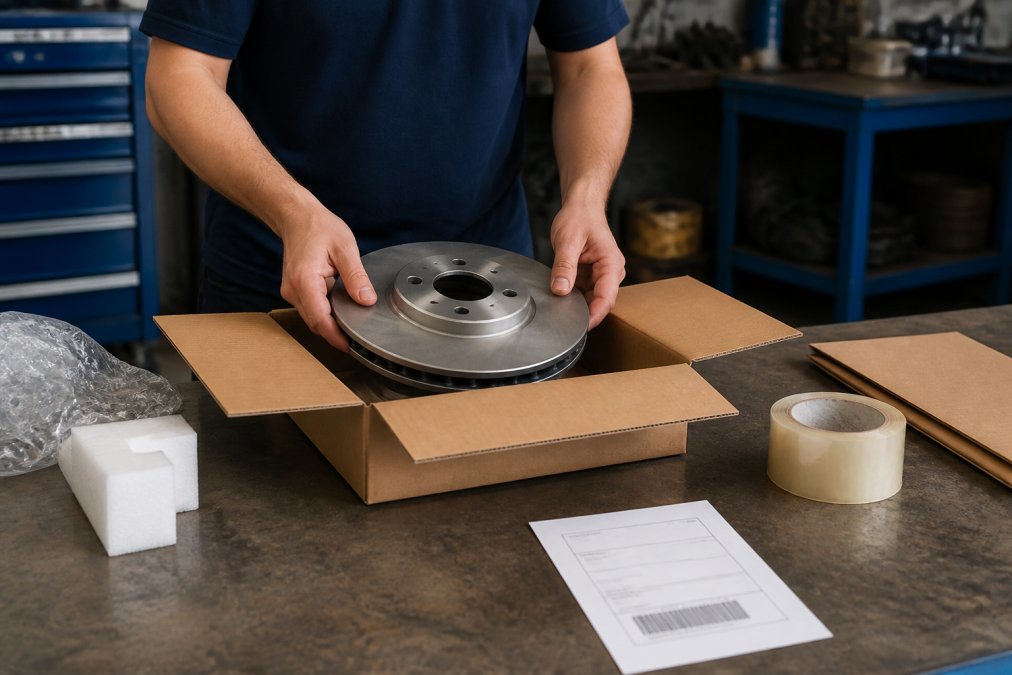
This step deserves real attention because automotive parts are heavy and dense. A genuine VW brake rotor weighs 18 to 22 pounds; a control arm can exceed 15 pounds (vw.com). If the part shifts inside the box during transit, it can punch through the cardboard and arrive damaged, and a damaged return is not the retailer's responsibility.
Follow this packaging sequence:
- Place the part back into its original factory box with all plastic wrap, foam inserts, and cardboard spacers exactly as they arrived.
- If the original box is damaged, use a new corrugated box at least 2 inches larger on every side than the part.
- Fill the void space with crumpled kraft paper or foam peanuts so the part cannot shift more than half an inch in any direction.
- For rotors or flywheels, wrap the machined surface with cardboard or bubble wrap to prevent scoring.
- Seal every seam of the outer box with 2-inch-wide packing tape. Do not use masking tape or duct tape, carriers reject boxes sealed with non-standard tape.
- Write the RMA number clearly on the outside of the box, and include a copy of the packing slip or return form inside.
Step 4: Choose the Right Carrier and Documentation
Most retailers use UPS or FedEx ground for return shipments. If the part is over 50 pounds, ask whether the retailer will arrange a freight pickup, since standard ground carriers impose surcharges for packages above 70 pounds. When you drop the package, request a receipt with the tracking number and keep it until the refund appears.
Step 5: Track the Shipment and Confirm Receipt
Track the package until the carrier confirms delivery. Most retailers process refunds within 5 to 10 business days after the warehouse receives and inspects the return (consumer.ftc.gov). If you have not seen the refund after 10 business days, contact customer service with your RMA number and the delivery confirmation.
Step 6: Understand the Inspection Checklist
The warehouse inspection typically checks five things: the RMA number matches the return, the part number matches the original order, the part shows no installation marks, the original packaging is intact, and all included components (bolts, clips, sensors) are present. Any failure triggers either a restocking fee or a rejected return.
Warranty vs. Return: Filing a Claim for Defective Parts
A warranty claim is not a return, and treating a defective genuine VW part as a return will cost you time and money. Warranty claims cover parts that fail due to manufacturing defects or materials that do not meet OEM specifications, while returns cover buyer-driven situations like ordering the wrong part or changing your mind.
When a part arrives defective or fails prematurely, skip the return process and file a warranty claim instead. Defective merchandise typically qualifies for a replacement or refund without restocking fees, and you should not pay return shipping for a part that failed through no fault of your own. Document the defect with photos, keep the part and its packaging, and contact customer service with your order number and a description of the issue.
Shipping damage is a separate category that sits between warranty and return. If a part arrives visibly damaged, note the damage on the carrier's delivery record, photograph the box and the part, and contact the retailer immediately. Most reputable sellers replace shipping-damaged items at no cost, but they need that documentation to file their own claim with the carrier.
Conclusion: Return With Confidence, Order With Certainty
The genuine VW parts return policy details come down to three rules: verify your part number by VIN before ordering, keep everything in resellable condition, and start the return within the window. Knowing the difference between a return and a warranty claim saves you from paying fees you do not owe.
EUROPEAN OEM PARTS makes this process manageable with genuine European OEM parts, exclusive pricing, and industry expertise that helps you order the right component the first time. Our team assists with VIN-based part number verification, and our fast nationwide shipping gets your vehicle back on the road quickly. Get started with EUROPEAN OEM PARTS and order with the confidence that comes from knowing exactly what you are buying.
Frequently Asked Questions
What is the standard return window for genuine VW parts?
Most genuine VW parts must be returned within 30 calendar days of the original ship date. The item must be in unused, resellable condition and ideally in its original packaging. To start the process, contact customer service for a return authorization number. Parts returned after the window without prior approval may be subject to refusal or a restocking fee. Always verify the specific return window for your order, as special order items may have a shorter timeline.
Are there restocking fees for returning genuine VW components?
Restocking fees depend on the item's condition and whether it was a special order. Standard parts returned in new, unused condition with original packaging typically avoid a restocking fee. However, parts that show signs of installation or are missing components may incur a fee, often up to 25%. Items ordered specifically for your vehicle, such as those requiring a VIN match, are often non-returnable or carry a higher fee. Confirm the VW parts restocking fee policy before ordering.
Do I need my VIN to process a return for VW parts?
Yes, having your vehicle identification number ready speeds up the process. The VIN is crucial for verifying part fitment and confirming that the return relates to the correct vehicle model and year. It also helps the supplier confirm the part number verification against what was shipped. If you ordered using a VIN-specific part, the return authorization will likely require that same VIN to process the refund credit correctly.
Can I return electrical parts if they have been installed?
Electrical components, such as sensors, control modules, or alternators, are generally non-returnable once installed. They fall under the non-returnable automotive parts list because electrical issues can stem from installation errors rather than manufacturing defects. If the part is defective, the claim falls under the warranty process, not the standard return policy. You will need to provide proof of purchase and may be subject to a diagnostic inspection before a replacement is approved.
This article was written using GrandRanker